The Modern Story of Salt

Santo gets ready for yet another hot day under the scorching April sun. His day starts at 6:00 am and undaunted by the long hours in front of him, he surveys the pans and walks the length and breadth of the chequered salt beds. His lean, dark body exposes his years of labour under the sun. His work gathers momentum as the day advances and the heat intensifies. But he knows that these are the conditions that are appropriate for the work ahead and he barely complains. With naked feet and a ‘foyem’ (the long wooden stick used to draw out the salt from the pan) in his hand, he moves from bed to bed raking up the crystals that are ready for harvesting. He makes small heaps on the intersections of the bed for the salt to dry. Once done with this, he moves to the next bed and continues the same.

Harsh realities

For Santo and his family, Goa is a second home as he comes from Belgaum, Karnataka every year in the month of October and sets up his makeshift home to live here for a few months. Right from the preparation of the beds and rebuilding of the bunds in the month of November, to harvesting the salt during February-May, the family toils on the land, exposed to the ravages of nature. The lands which are submerged in water during monsoon every year, come alive from November-May and creates an opportunity for people like Santo to make a little money before they go back to their villages to work as field hands for the rest of the year.
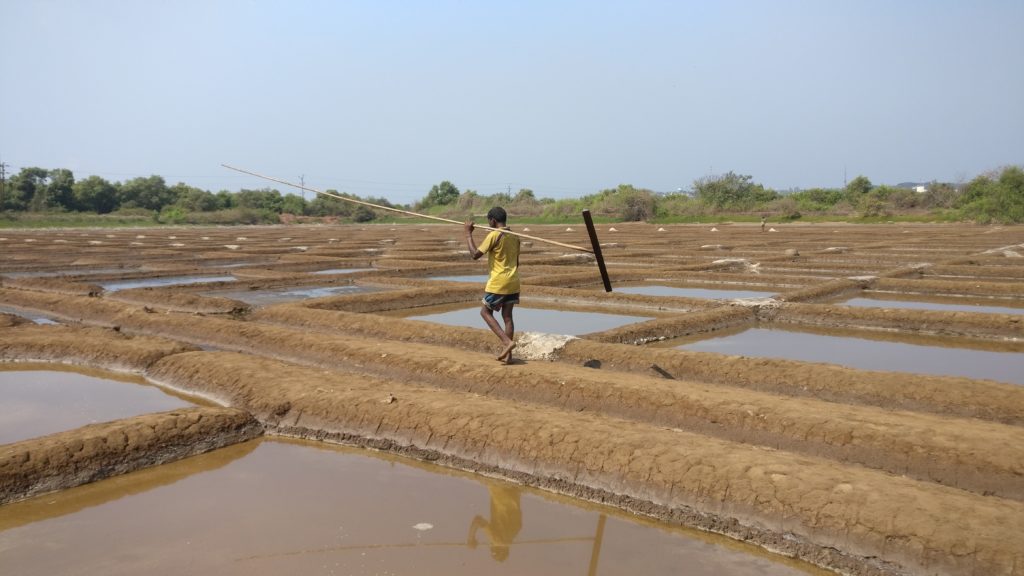
Santo making his regular checks of the bunds (April, 2019)

It has become highly difficult to find a skilled labourer in Goa as the younger generation is reluctant to learn the trade for want of more lucrative options. Added to that is the intensive labour involved and the declining demand for the unrefined salt that is an intimidating factor for the youth. Hence, out of 36 villages which produced salt in Goa earlier, only a handful of them are still functional to keep the occupation alive with the produce barely catering to the domestic market.
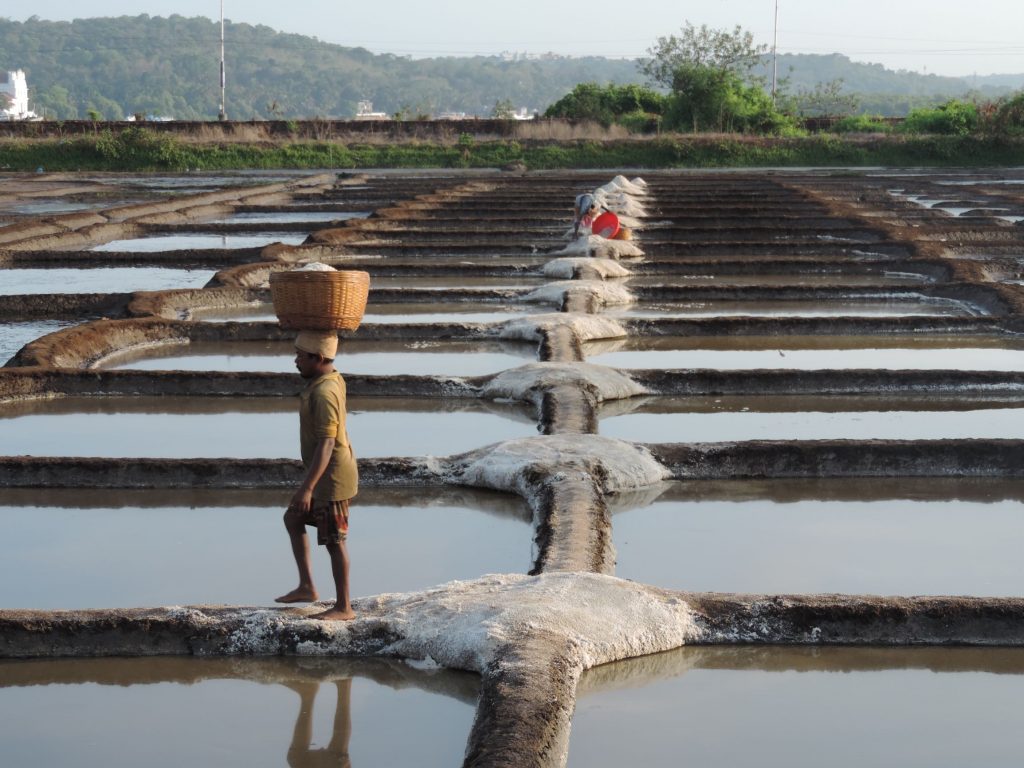
Ribandar Saltpans (May 2020)

Michael, another mittkār from Batim, Goa, laments that his sons are least interested in the work he has learnt from his father at the age of 11. His sons don’t share their father’s passion as this would mean 10-12 hours of work every day under the sun. At 65, Michael works through the day not just to use his ancestral lands and continue this traditional occupation, but because this is the only work he has learnt. “I dropped out school after my 7th std and learnt the work from my father. Since then I have been working in these fields”, he said, with surprisingly good English for an ‘uneducated’ man. Michael is one of the few Goans who is still trying to hold on to his lands. During the monsoon days, he cultivates his land and grows traditional rice varieties that are grown is saline lands like Kohrgut, Assgo, Khochro etc.
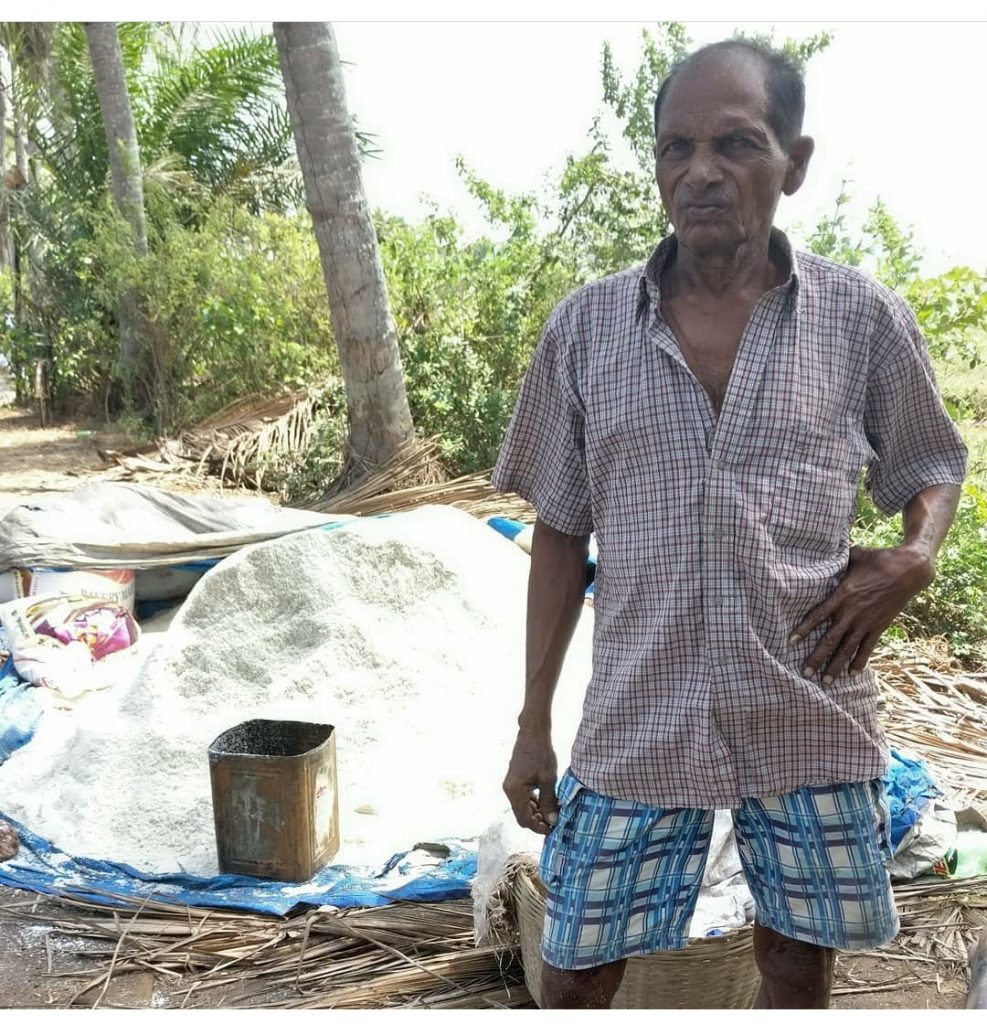
Micheal from Batim, Goa (May 2019)

Khazan lands

Traditionally salt was made by the evaporation of sea water or by extracting salt from the salt mines. Local biodiversity and suitable geographical and climactic conditions are pre-requisites for the building of salt pans. Solar extraction needs saline water supply that is regulated using sluice gates built in two different places. The Ribandar salt pan, for example, gets its supply of water from the Mandovi River depending on the need and the movement of the tide. The khazan on the other side of the Ponte Conde de Linhares (the causeway connecting Panjim to Ribandar) gets filled up which then is allowed, when necessary, through the second sluice gate, to enter the beds provided for evaporation and crystallizing of salt. The salt thus extracted has essential minerals that disappear in industrially refined salt. Khazans are waterlogged reclaimed lands that are used for agriculture, fishing and salt-making.
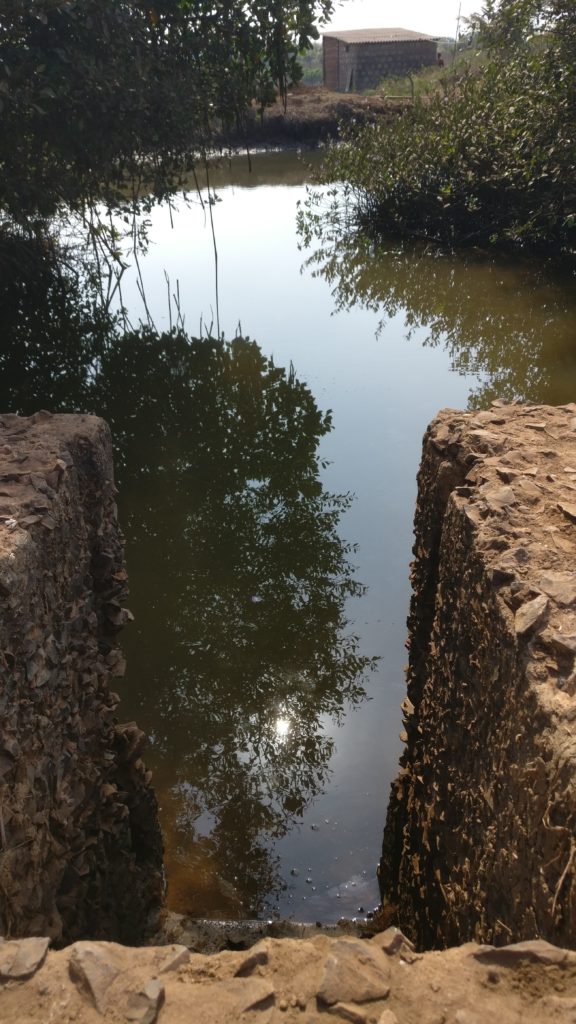
Sluice gate allows water to seep in from Mandovi river during high tide

A visit to these places would expose the stark truths of the disappearing khazans from the Goan landscape, environmental pollution, shrinking of the mangrove cover all across Goa due to developmental activities and finally the general tendency of people who are moving away from healthier and indigenous food and culture for a more dangerous modern industrially and commercially made produce. Many of these lands are also being used by many for agriculture and pisciculture, which, many believe, is commercially more viable. Goa has many such khazans which are habitats for crabs, shrimp, mud skippers and also migratory birds. Hence destruction or abandoning of saltpans also affects the biodiversity of these hotspots or vice versa.

Pickling and more

Salt is not just used to enhance taste of food; its use as a preservative has been discovered thousands of years back. Many families in Goa still use the unrefined sea salt for curing their meats and making pickles. Preservation and drying of fish is another very important activity for which traditional salt is essential. Today, salt is being fortified with iodine and sometimes iron as deficiency of any one of these leads to serious illnesses. Additives are also used to make it free-flowing according to the dietary standards and Food and Drug Administration (FDA) regulations in each country. The Goan sea salt has a slight brownish tinge which comes because of the essential minerals and not because of any impurities. It has a distinct taste that gives food a burst of flavour. There are many families I know who use only the local sea salt for their daily food preparation.

Joaquim, Santo’s employer, leases out the land to the family every year and is happy with the produce that he gets. He does brisk business selling the salt to the local traders, as time is limited with the fast approaching monsoons that hit Goa by the end of May or beginning of June every year. The entire quantity of salt produced is not just for human consumption. The batch that is harvested initially is dirty and is hence used as a fertiliser for the coconut plantations that thrive in saline conditions. The salt produced subsequently is used for human consumption, explains Joaquim. He has good domestic market for both the varieties.
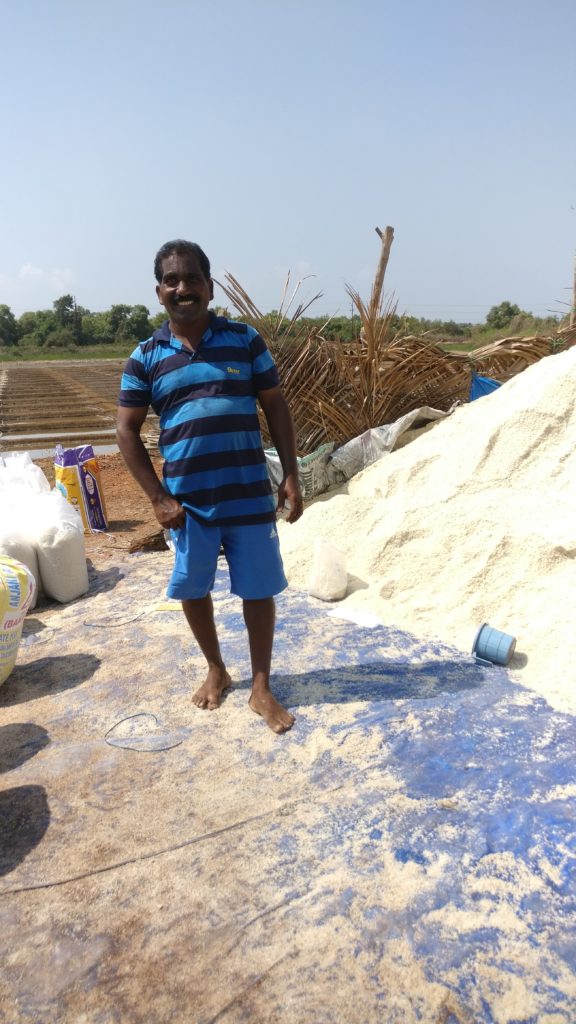
Joaquim, optimistic about the future (April, 2019)

Goa being coastal area has reaped the benefits of salt-making and this occupation has been in practice for the last 1500 years. Saltpans, which are built in khazans, have helped the Goan mittkar (mīt is salt in Konkani) yield good amounts of salt enough for export in the earlier times. Like any other traditional occupation, salt making also is facing the modern challenges from the lack of skilled labour, mindless commercialization, lure of ‘better’ opportunities and ‘lucrative’ jobs, lack of government support, and of course declining demand for the product. Though some of the traditional skills and occupations die a natural death like pottery, some are only getting extinct for lack of suitable support from society and government agencies.

Economic Recession 2020

A visit to the pans is a ritual for me every year either to pick up a few bags of salt for my domestic use, or just to walk around watching the mittkārs work on the salt fields. This year, as the lockdown eased a little, I visited the salt pans in Ribandar, hoping that situation is not as bad as elsewhere. To my pleasant surprise, along with Santo, there were a few more people working on the salt fields, oblivious to the pandemic scare that has gripped the world. I was elated to know that salt business this year has not been drastically affected. I could not meet Joaquim but a chat with a worker (he was reluctant to reveal his name) who has returned from the field for a brief rest, told us that business is as usual and that the pandemic has not really affected the flow of their regular customers. Luckily, this is a time-bound occupation, and a commodity that is entwined with Goan traditional calendar. Hence the season closed on a positive note for the mittkārs of Goa.

Summer 2020 in Goa has changed many things in many ways. As the world woke up to the possibilities of an unpredictable future, in several ways, Goa too woke up to shocking realities – of recession, unemployment and a bleak future. It is heart-warming to see that many who moved away from traditional occupations, are coming back to till their lands to become self-sufficient. It is a sign of prosperity but time will tell whether this change is impulsive or permanent. I thought of Michael, whose sons were earlier reluctant to become mittkars or farmers and hoped that they have decided, after all, to assist their father in his work and preserve their precious lands.
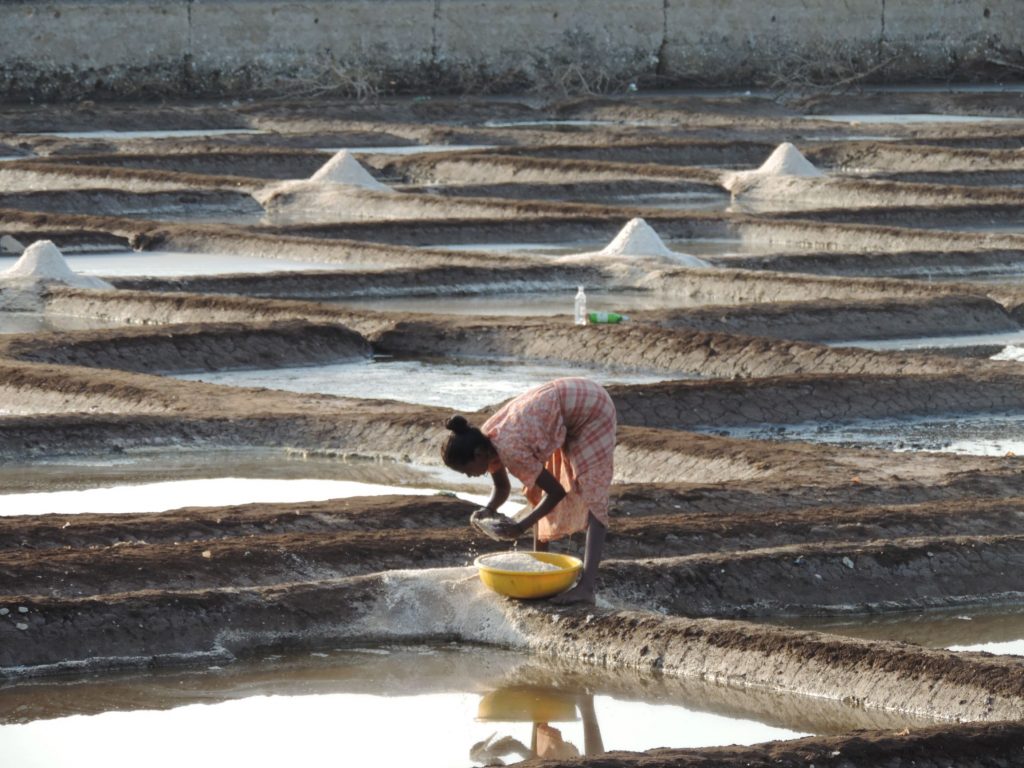
Ribandar Saltpan (May, 2020)

The history of salt recounts the history of human civilization. Its importance is not only as a seasoning ingredient but also as an important additive in several medicines. History states that wars have been waged, slaves have been exchanged, routes were laid, ceremonies were held and cities were named around the importance of salt to the humanity.

For Santo and Joaquim and their ilk, yesterday is already gone and tomorrow is yet to come but today is already here…and that is what matters the most.
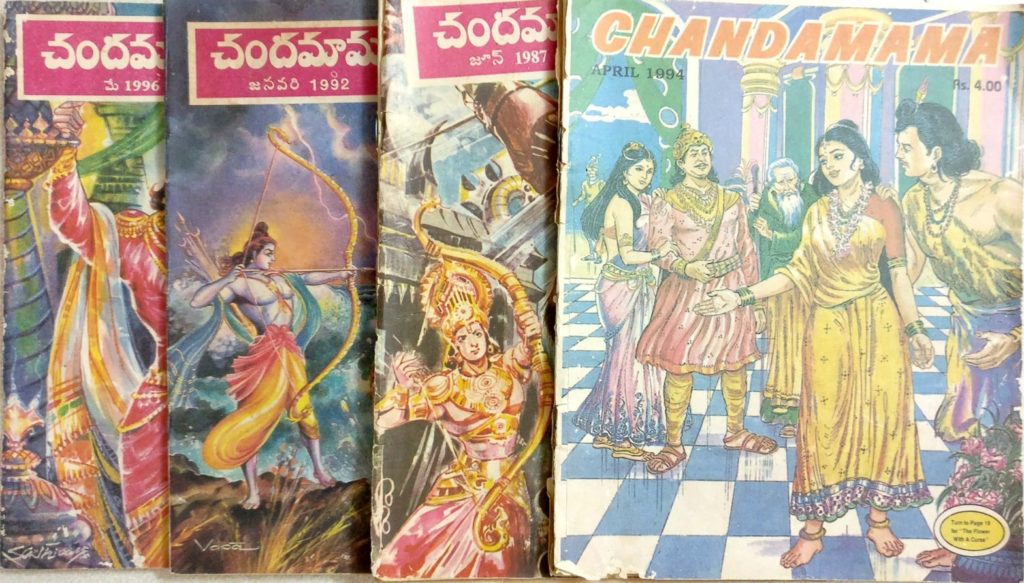
My Companion for Life – Chandamāma

My father is a voracious reader and collected thousands of books from Jiddu Krishna Murthy to Dennis the Menace, Winston Churchill to Ken Follet and owned an entire cupboard of the Reader’s Digest magazines right from 1960s. Unable to keep track of so many books, he has recently gifted the extended family many of them, donated boxes of books to a good neighbourhood library, kept a few favourites for his himself and parcelled the rest to my sister and me. Excited and happy, as I opened the cartons surveying the books carefully, out popped several bound copies of our most favourite magazine from our school and college days, the Chandamāma.

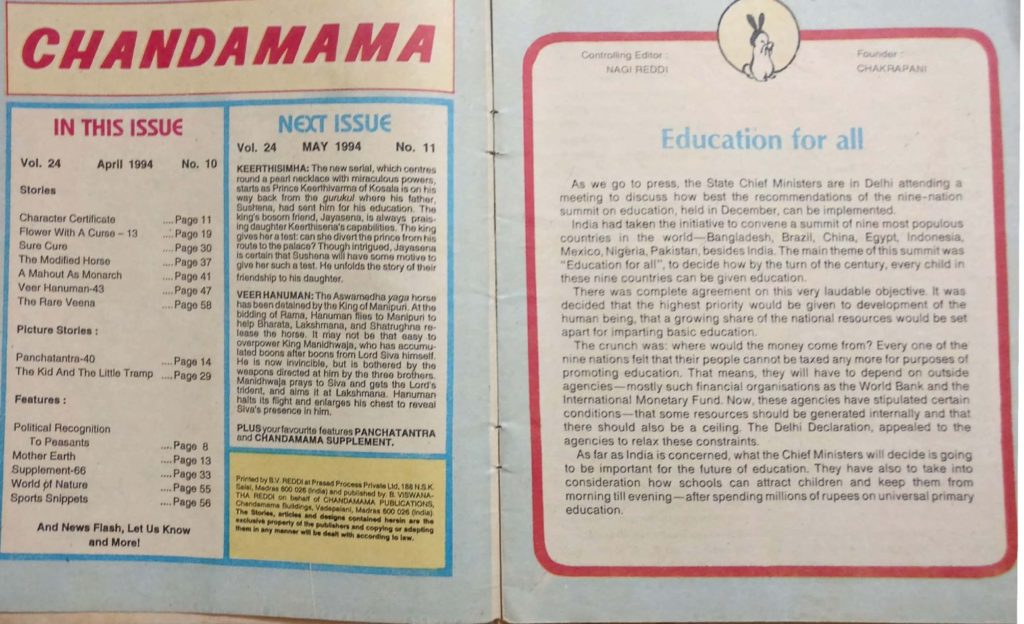
If you were in school in Andhra Pradesh in the 1980s or before and have never heard of Chandamāma, then you were probably not somebody who cared for reading much. It was a monthly children’s magazine started in 1947 by the popular director/producer and screenplay writer duo from Telugu filmdom, B. Nagi Reddy and Chakrapani. Chandamāma quickly became popular with children and adults alike and eventually the magazine was published in English and 13 Indian languages. Each issue brought out stories with simple morals and life truths that were woven around simple folk. Mythological stories, parables, folklore, fairy tales abound in each issue all of which made a lasting impression on generations of Telugu readers. Surprisingly, though most of the stories were set in rural backdrop, many who lived in towns and cities like us could read, enjoy and relate to them.  The magazine which ran for 60 years apparently was published till 2008, with many changes made for the contemporary reader and society. What remains today are the kindle version of digital copies right from the first issue in 1947. I am now the proud owner of copies from the 1980s and 90s but with a few missing.

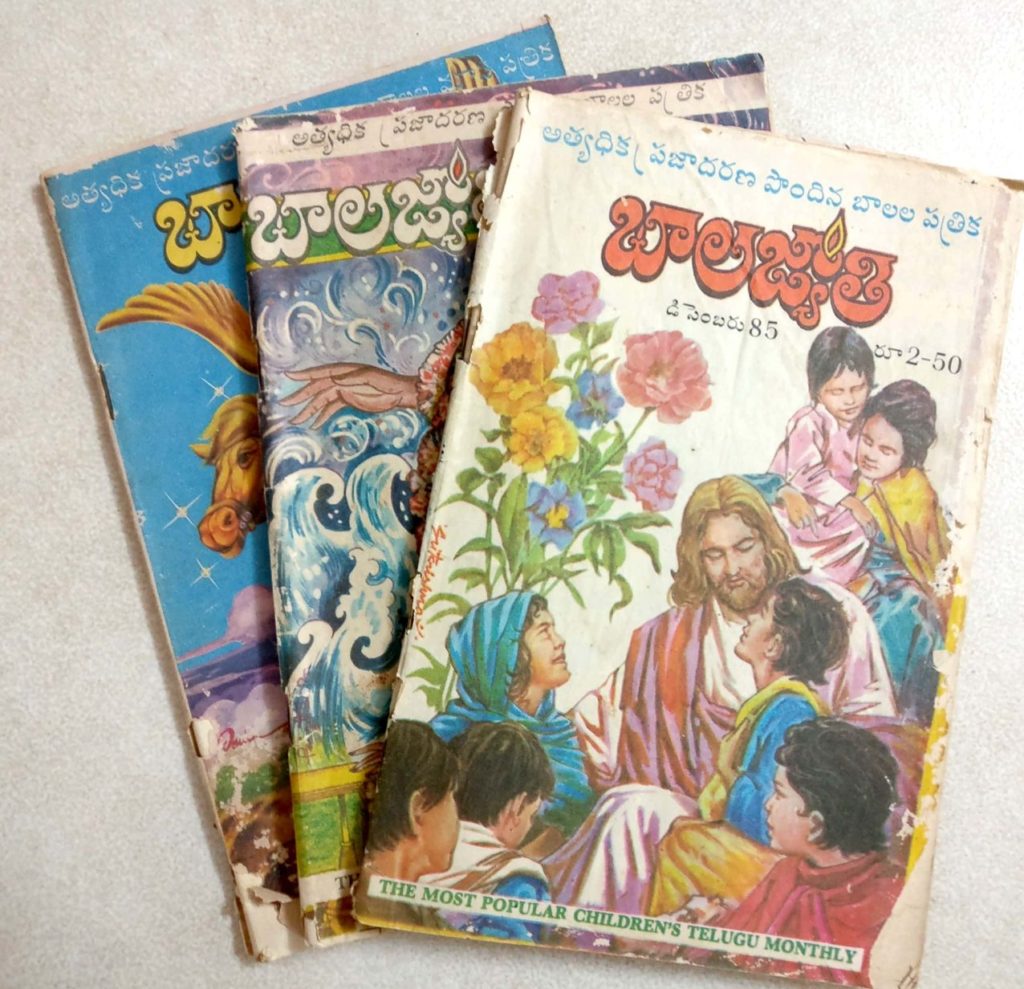
Growing up in the 1980s in Vijayawada, (an important commercial city from South Indian state of Andhra Pradesh), Chandamāma was so much part of our lives. Our pocket money every month was invariably spent on Chandamāma, and another popular Telugu children’s magazine called Bāla Jyoti. Our frequent visits to my maternal grandparent’s village, Godavarru, on the banks of river Krishna, formed a strong foundation for my love for bucolic life. Chandamāma had practically been a huge part of our formative years and influential in our learning process. Each story, written in simple Telugu, was both entertaining and educational. While the writing style was didactic, the themes of the narratives were never dogmatic and preachy. Virtues like honesty, charity, discipline, hard work, humility were all taught through simple characters. So in the story Kodi Khareedu (The Price of the Hen), when the village smith Perayya was cheated of his money by the landlord of the village Kotayya,  in the end the latter was made to realise his mistake and was punished severely for his greed (July 1983). Amulyamaina Aasthi (Priceless Possession) is about Saambu, a poor village goatherd and flutist who was given a job in the court of King Vikramasena as the keeper of the Treasury. In the wake of rumours of the King’s favouritism towards Saambu, the courtiers blame him for fraud and deceit. Saambu proves to the court that his flute and his ragged outfit are far more precious and priceless than material wealth. Young readers were gently taught that greed, jealously, indolence, deceit will not only make their life miserable and unhappy, but will also not make them successful. The magazine also published folklore and stories from other countries like the Armenian folklore “Bangaaru gulaabeelu” (The Golden Roses). The story is about two honest farmers who were gifted with a rose plant with golden flowers. The plant disappears every time the greedy Prince wanted to pluck its flowers. The story ends with the moral that we should not covet what others possess and earned through hard work (November, 1983).

Copies of Bala Jyoti, another favourite children’s magazine

The magazine also carried fantasy serials like Mugguru Maantrikulu (The Three Sorcerers) and Betaala Kathalu which was adapted from the famous ‘Betaal Pacchisi’ written nearly 2,500 years ago by Somdev Bhatt.

The Telugu writer and revolutionary, Kodavatiganti Kutumbarao, popularly known as Ko Ku, edited the magazine for 28 years (1952-1980). Neither the writers nor the editors ever advocated any caste, class, religious, racial or gender discrimination. The mythological stories were written and edited by Kutumbarao in a style which was easy for children to understand.

The popularity of the magazine also came from its colourful illustrations which attracted the young minds to reading and learning. Each issue came with unique and vivid cover design and the tales captivated the readers with their life-like pictures making the characters and settings come alive. Famous artists like M. T. V. Acharya, Vaddadi Papiah (Vapa), Kesava Rao (Kesava), M. Gokhale, T. Veera Raghavan (Chithra) and several others were associated with these memorable illustrations.

Holding these copies of old Chandamāmas in my hand, I felt really glad that we were prudent enough to save a few of these gems for posterity. Flipping the pages, I almost felt I heard a few voices from the book talking to me and I quickly got engrossed in the stories, reconnecting back with my long-lost companions.

Ferry Services – The Lifeline of Goa

Goa is endowed with natural waterways that are navigable throughout the year. A lot of commercial activities as well as enterprising travel and tourism activities take place using the vast network of waterways, making Goa well-connected. Crisscrossing this tiny state are the major rivers like Mandovi, Zuari, Sal, Terekhol and Chapora that flow past the remotest villages and islands of the state thus easing the travel time of many people. Government and private run cruises for tourists and floating Casinos fill the Panjim coastline giving a boost to the tourism development in the state.

Identifying the need to tap the waterways, ferry services were established during the pre-liberation times which are still very popular and are essential commuting service in the state. Taken care of by River Navigation Department (RND), Government of Goa, there are 19 ferry crossings across Goa and catering to people as well as vehicles which are ferried across the river at the same time. Services in some places start from 5:00 am and end as late as 2:00 am in some places. According to the River Navigation Department, around 2.5 lakh commuters and 18,000 vehicles use ferry services across Goa.

ferry boat

Living in Panjim, some of our Sundays go into exploring the island of Divar which is connected only by a ferry. Of the many things that excite us during our expeditions is the ferry crossing. There are two terminals to go to Divar – one from Ribandar and the other from Old Goa. Both offer quick and very prompt service and the entire crossing lasts for not more than 5 minutes.  Every ferry has a ticket collector and a driver employed by the Government of Goa. While cars are ticketed for as low as Rs 7-10, it is free for people who use the service. Manoj, a ticket collector on one of the ferries smiles when I ask him about the ticket price.  “It is a government service. Fuel and salaries are borne by government.”

Screenshot_20190330-153052-354244596-1553940954834.jpg

Many islands like Charao and Divar are only connected via waterways and a large number of residents of these islands commute every day using these shuttles. Generations of families have lived on these islands and ferry crossing has been part of their lifestyle. While many, especially the younger generation, find it inconvenient to depend on these shuttle services for obvious reasons, there are several who are resisting the construction of bridges across the rivers. For a large number of people, it is the fear of the rapid commercialization that Goa has been experiencing for the last couple of decades with the ‘intrusion’ of ‘the outsider’ (bhaile in Konkani).  Anthony, a resident of Divar is torn between the idea of better transportation facilities and preserving the resources of the island. “Our families have been living here for generations. Sometimes when there are delays in the morning on the way to work because of crowded ferries or a breakdown of the ferry, our day is disrupted. That’s when I feel the need for a bridge,” he says. Many like him prefer a quiet and serene rural environment far from the temptation of the hustle and bustle of a commercialized city. Some ferry crossings like the one between Kerim-Tiracol and Panaji-Betim also have bridges but many still prefer a ferry to save fuel and time.

With all its temporary hitches and snags, a ferry ride is still one of the most romantic aspects of a Goan lifestyle. Whether you are a tourist or a local resident, enjoy some lazy moments on a ferry boat for that unique Goan experience.


The Market with a Goan Flavour

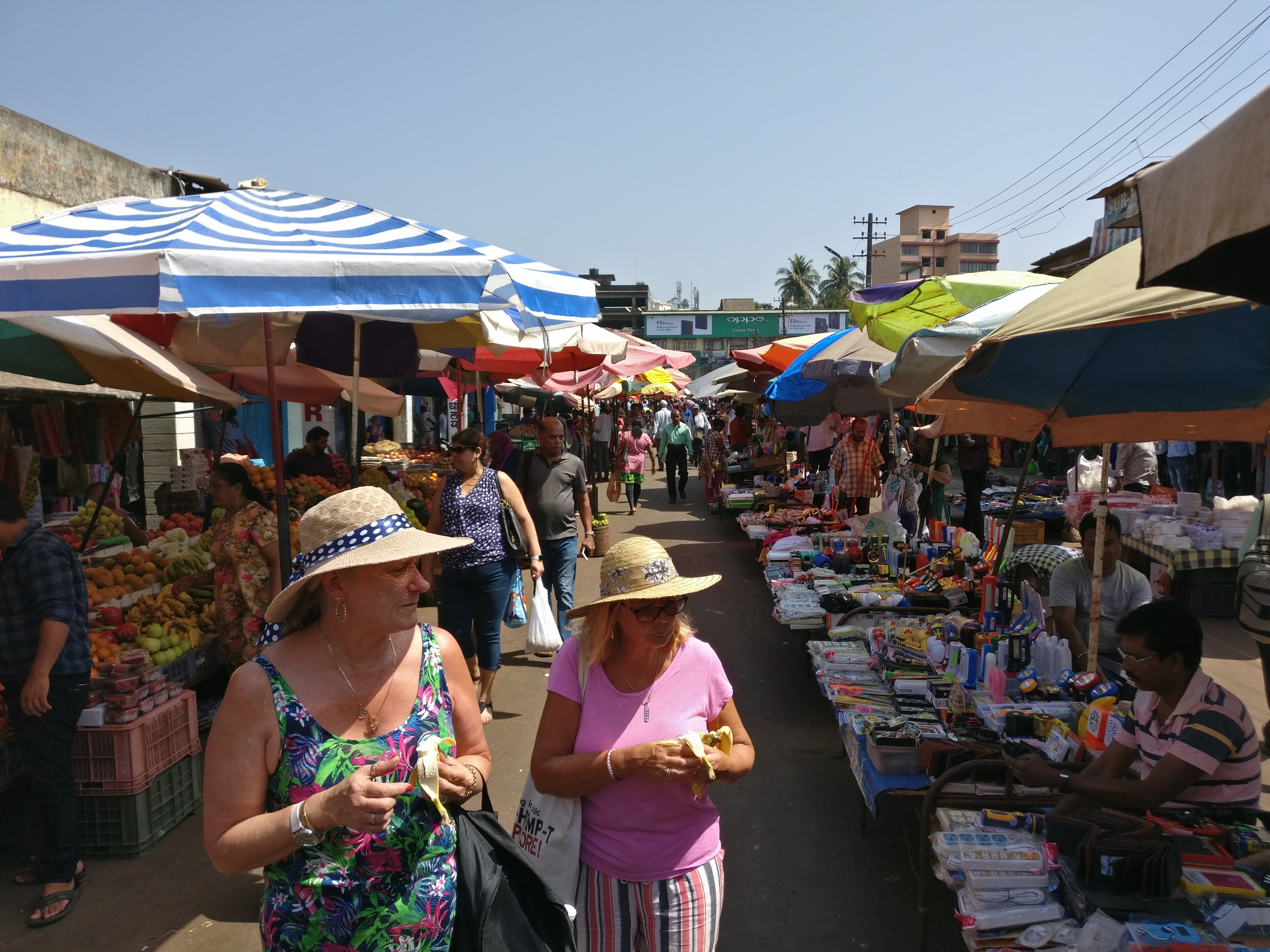
If you are a traveller who loves learning about people and the cultural heritage of the places you go, then visiting a marketplace is a great way to begin your journey. This time when you are in Goa, add to your list of things to do, a visit to Mapusa Friday Market which is probably the only traditional market place in Goa.

IMG_20190322_104406

No one knows when exactly Mapusa market had become popular exclusively for its Friday market, but this busy town has always been an important market place in North Goa. The Mapusa Municipal market area, located right next to the Mapusa bus stand is very conveniently located and could be one of the reasons for its thriving trade and commerce. This place especially comes alive every Friday with vendors and farmers selling their home-grown produce in their makeshift shops. The place throngs with the local residents and people from the nearby towns who come to buy and stock local produce for economical rates.

IMG_20190322_102918

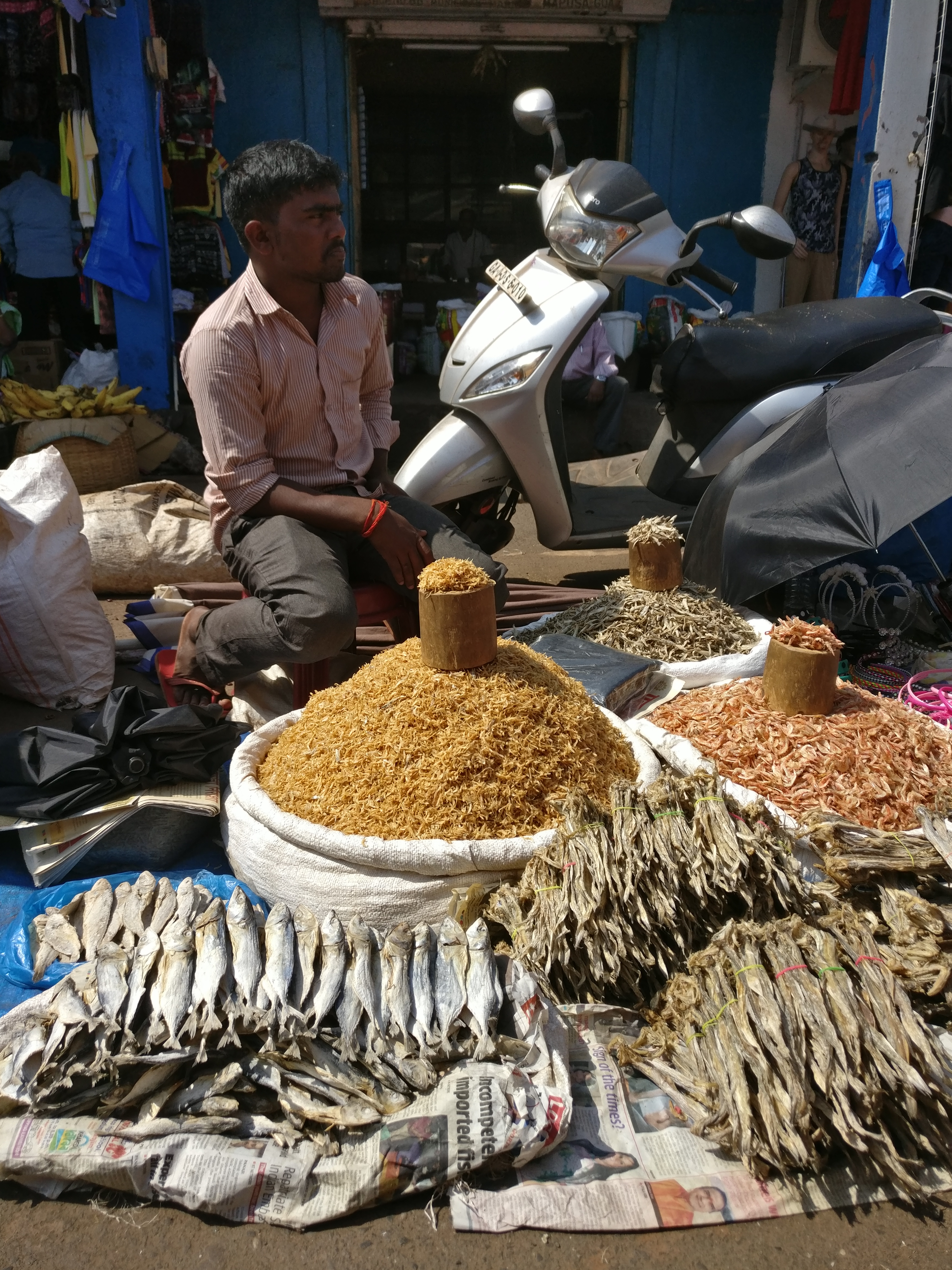
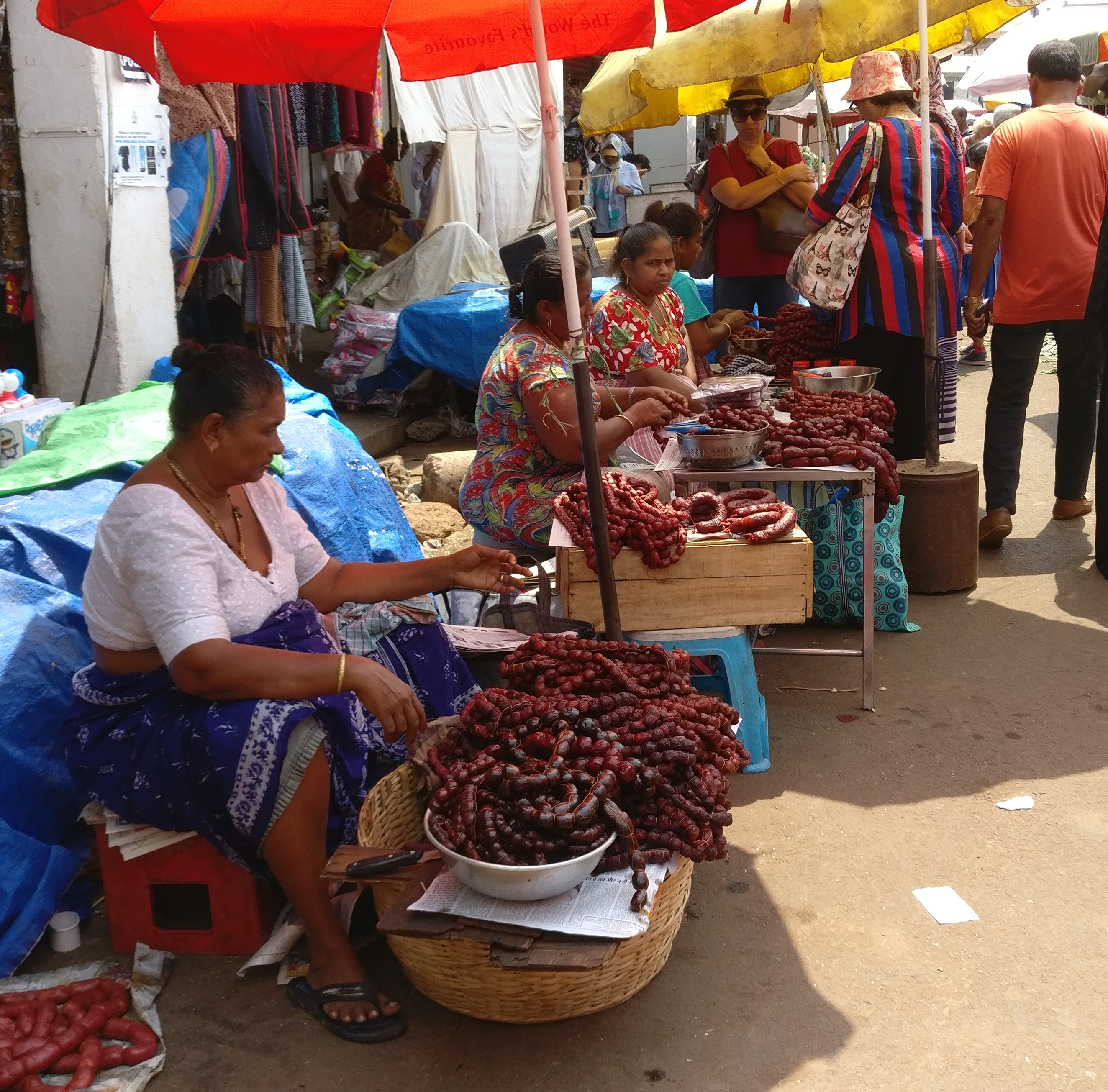
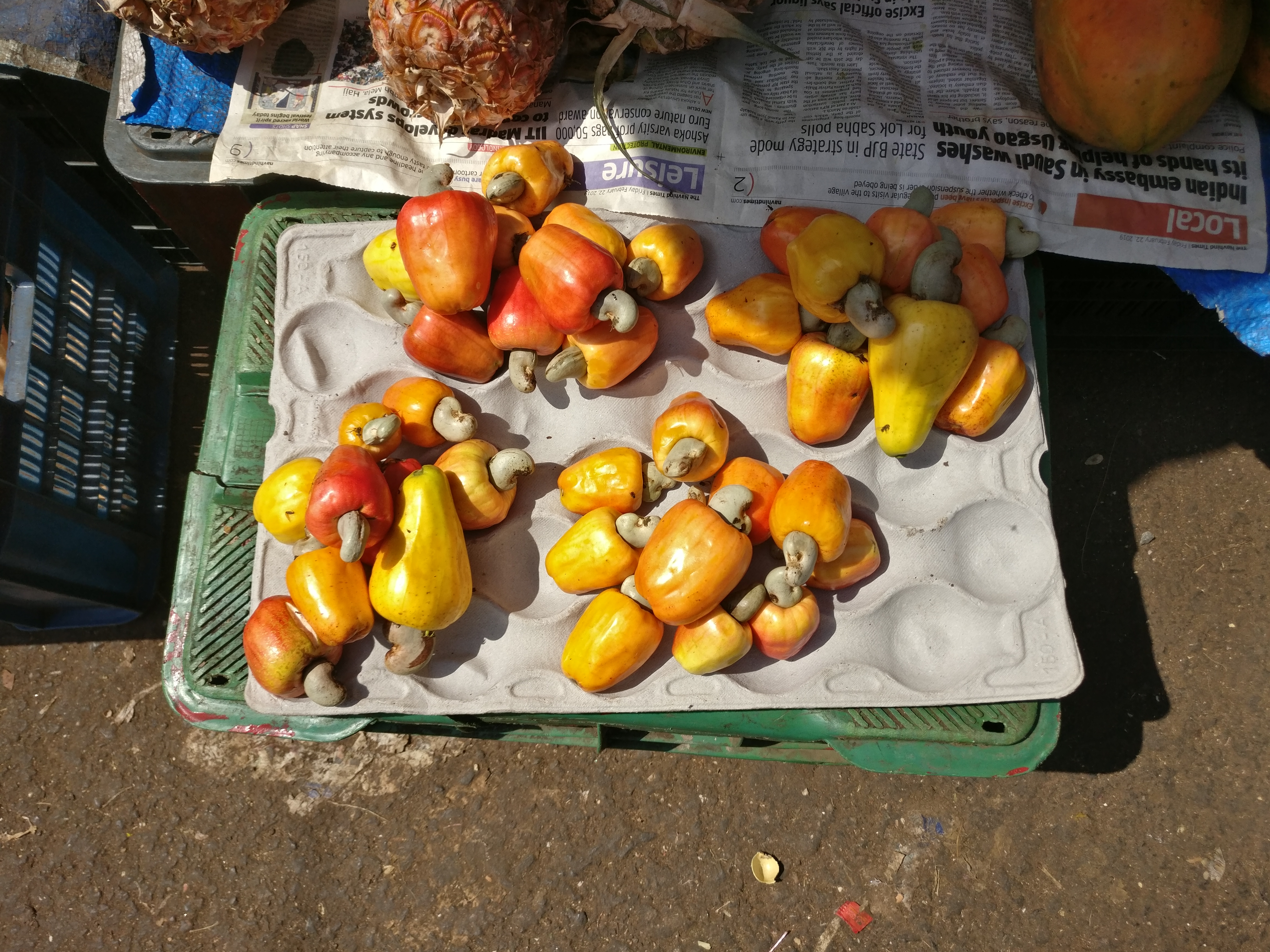
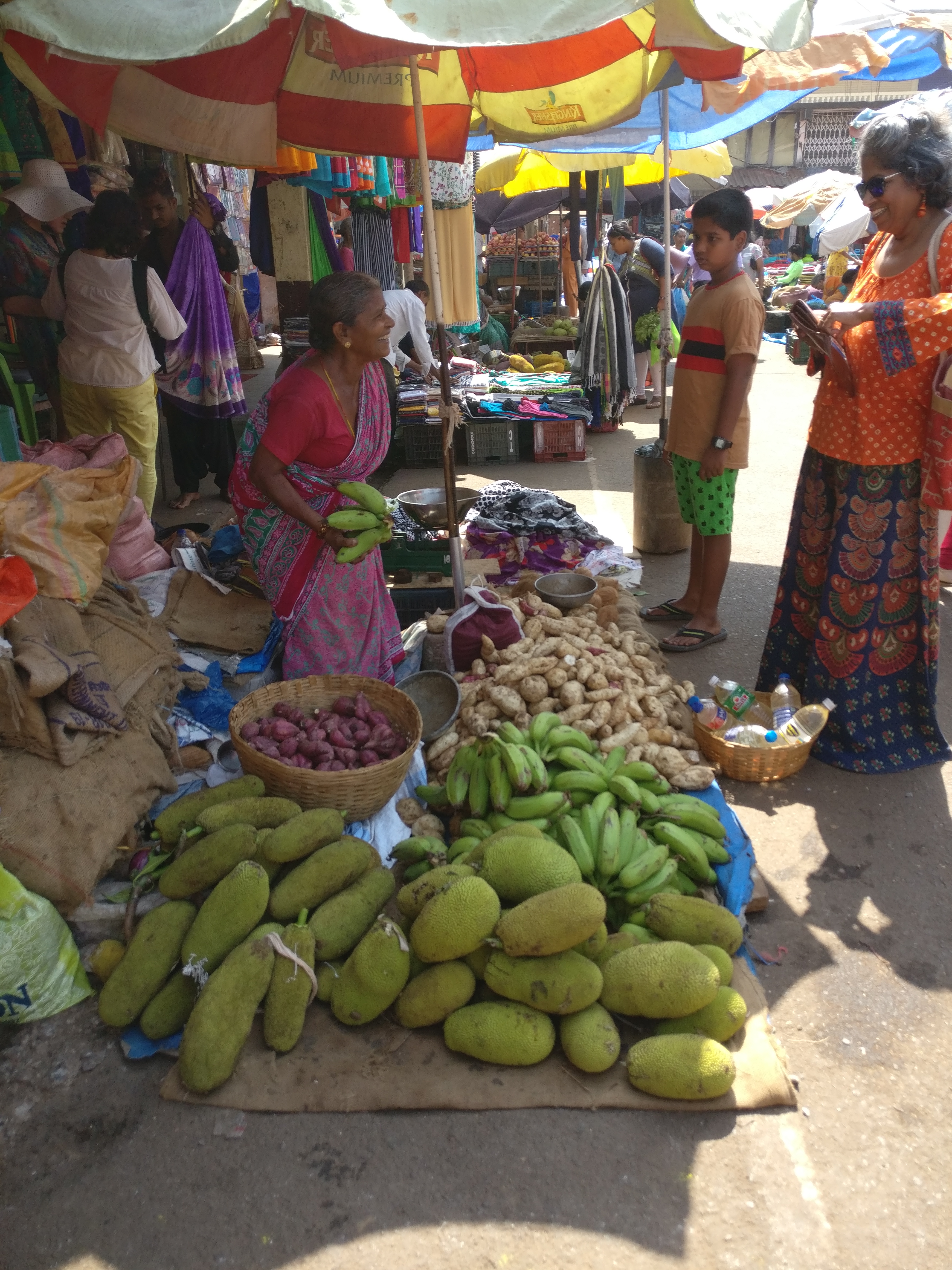
I never miss going at least a couple of times to the Friday market during the summer months. It is a treat to one’s epicurean eye, the display of home grown vegetables, fruits, pulses, fresh and dried fish and home ware such as earthen pots and vessels, locally made iron pots and pans and domestic tools, locally woven coir ropes and mats, brooms made with coconut leaf stalks etc. March to May, the market is filled with raw mangoes and sacks of red chillies and other necessary condiments required for pickle-making. Goa observes annual fishing ban during the monsoon months of June-August as it is the spawning time for fish and also is risky to sail on choppy seas. Hence people buy and store dried fish to last the season. Woven bunches of shallots, chillies, seedless tamarind, dried and deseeded kokum fruit, strings of the spiced  and marinated Goan pork sausages called Chouriҫo and certain condiments used in the local cuisine are bought in large quantities by many Goans as the wet months don’t offer good produce.

mapusa

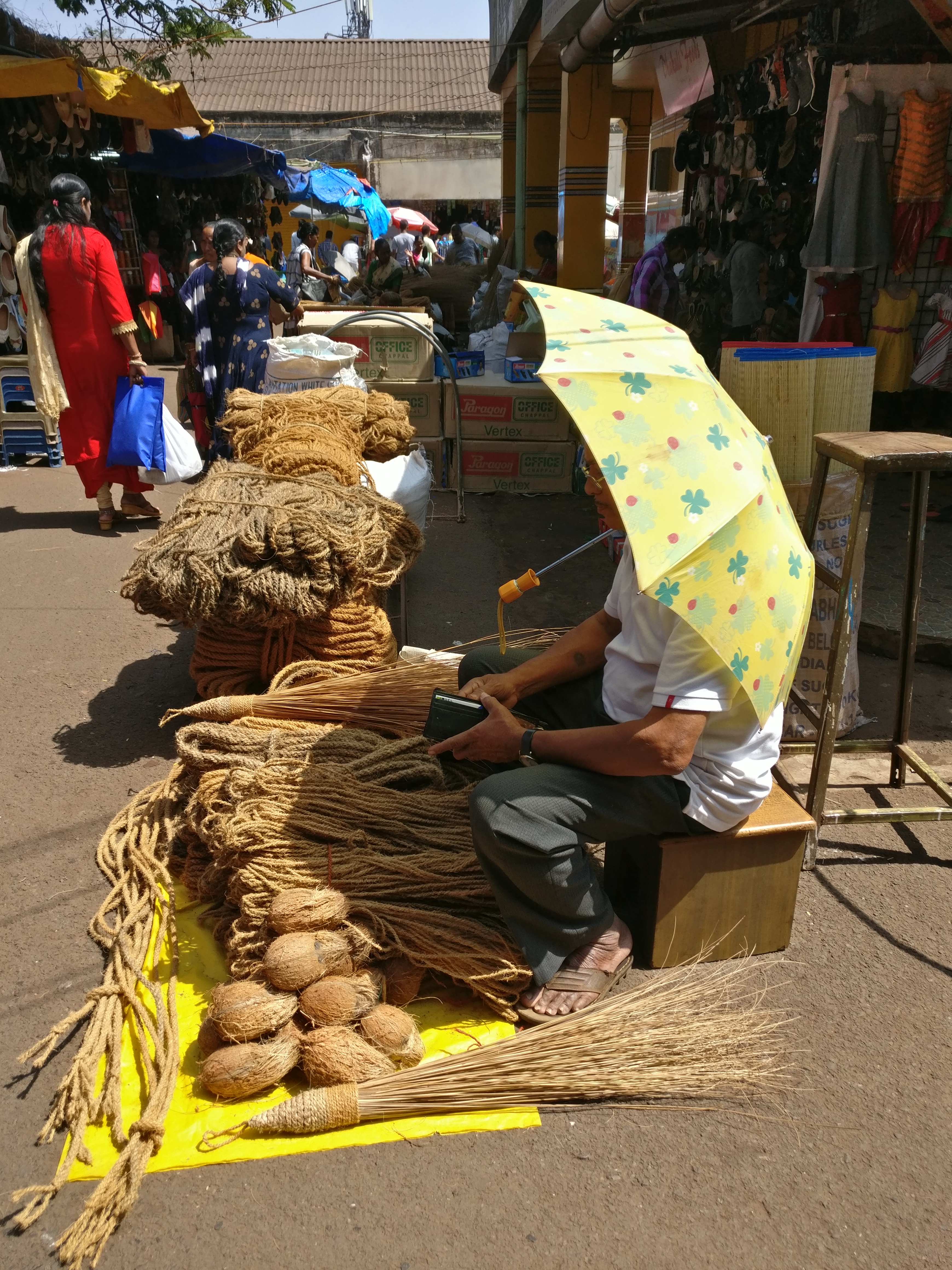
Rosy, a woman from Pernem who has a permanent shop in the market that sells earthen ware, is happy that even during summer she has good business with people coming to buy earthen. In spite of having a refrigerator at home, many prefer cool water stored in these earthen pots especially during the hot days of April and May. Along with these, she also sells many other earthen containers and cookware that the Goans use to prepare food. Kashinath, another vendor who comes every Friday to sell his coir ropes and coconuts, seems happy with his temporary space for the day. He makes and sells coir ropes of different thickness and is one of the few in the area to have such a variety. Comfortably seated and protected by his huge umbrella on that sunny morning, Kashinath proudly explains his routine. “I make all these ropes at home and sell them usually from home. On Friday, I come here to make a little extra money as I make brisk business here. When I am busy, my wife or mother take my place.”

IMG_20190322_105539

Besides the local products, the market is filled with shops that sell inexpensive clothes, colorfully embroidered bedspreads and quilts, steel kitchen ware, kitchen and garden tools etc sold by sellers who come from other states. Bargain smartly to get good deals for some of these items.

IMG_20190322_104021

IMG_20190322_103705

In spite of the continuous flow of crowd and the swift and busy trade that takes place throughout the week and especially on a Friday, the market is kept clean by the Mapusa Municipality. Traffic is a little haphazard on a Friday but there are paid parking lots managed by the municipality personnel who can assist you with a parking slot. Most of the local vendors understand and speak basic English and help you make your purchases patiently.  On a hot and humid day, be sure to wear comfortable cotton clothes and a hat. Visit the market early so you can avoid both the milling crowd as well as the heat of the day. But whatever the time of your visit, the market is sure to leave a few worthwhile memories to carry back.

St. Cajetan Church – Abode of Peace and Serenity

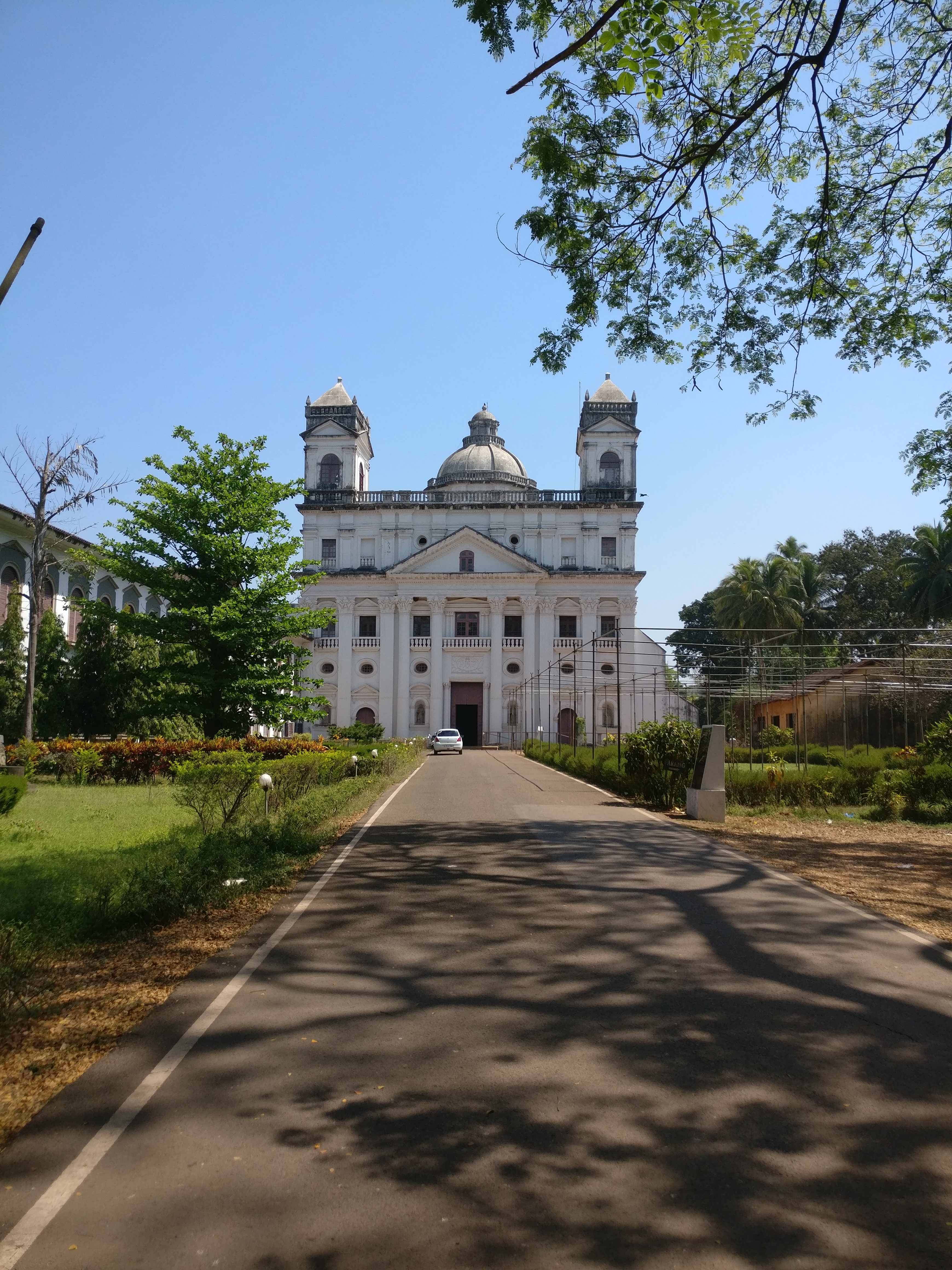
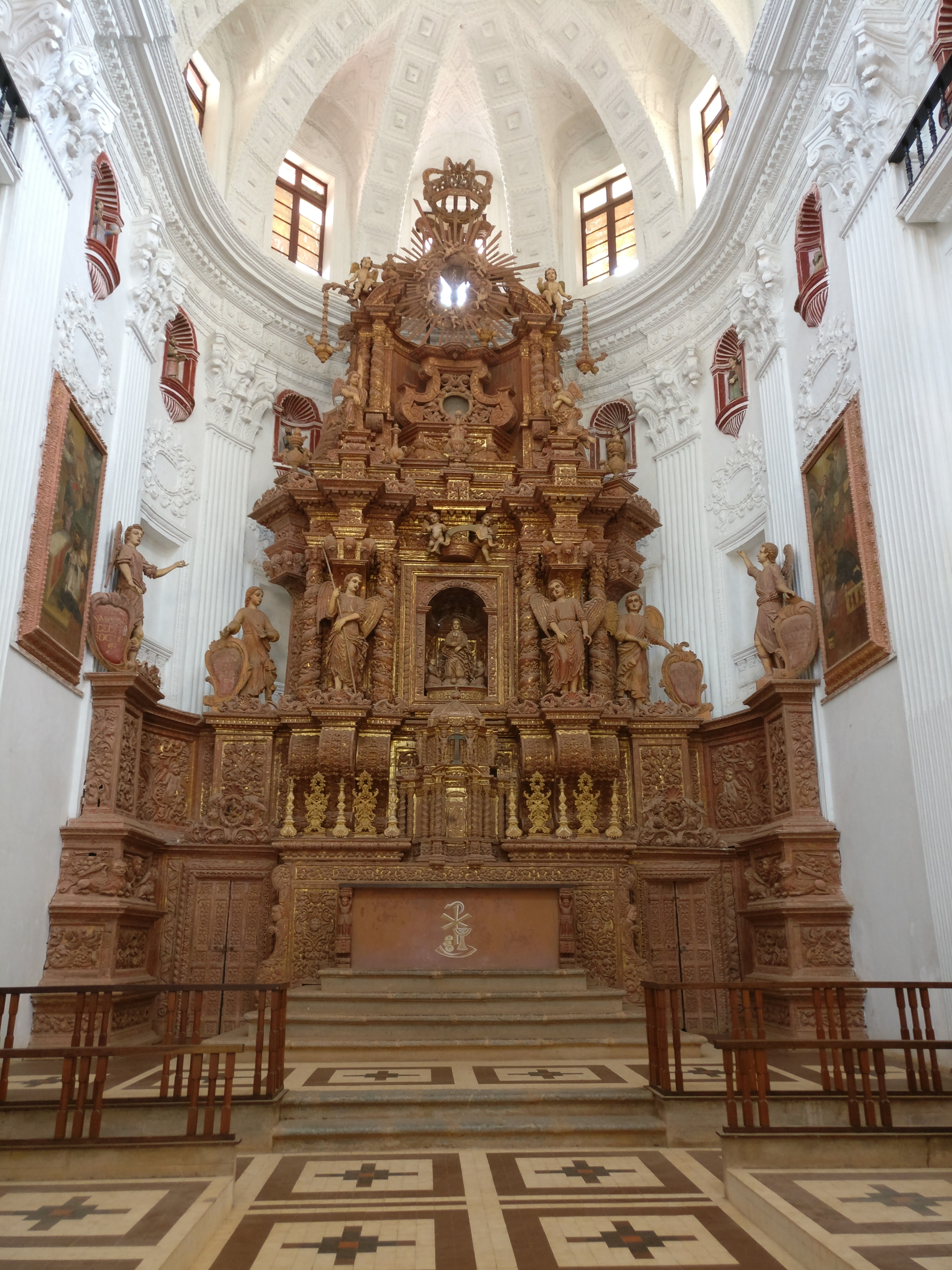
If you take a turn into the lanes behind the Se Cathedral, Old Goa, you come to one of the most unique churches of Goa, the St. Cajetan Church and convent. Housed on a spacious land, surrounded by huge, old trees, and landscaped gardens, the church stands royally, as if looking heavenwards. Also called Velha Goa, Old Goa was the earlier capital of Goa during the Portuguese rule before it was shifted to Panjim (‘Velha’ in Portuguese means ‘old’). Though constructed by the Bijapur Sultanate which ruled Goa before the arrival of the Portuguese, it later became the seat of Roman Catholic Church of the East during the time of Portuguese rule.  Hence it houses many churches and chapels, the most famous of them being Se Cathedral and Basilica of Bom Jesus.

cajetan 2

Saint Cajetan was an Italian priest, a religious reformer and the co-founder of the Theatines Order of the Christian Faith. Recognized as a saint by the Catholic Church, his feast day is celebrated on 7th August every year. It is believed that during the Portuguese regime in Goa, three Italian priests, on the command of the Pope, arrived to spread Christianity in 1639 and planned to build a hospital. Their work was interrupted by the Portuguese Viceroy Felipe Mascarenhas, but the priests eventually sought permission from the then king of Portugal, Dom Joāo IV. After building the hospital in 1955 they set up a church and a convent close to it. The church hence is supposed to have been modelled on St. Peter’s Basilica of Vatican City by the Italian architects Carlo Ferrarini and Francesco Maria Milazzo. Although the church is originally dedicated to Our Lady of Divine Providence, it was later named after St. Cajetan, who was a contemporary of St. Francis Xavier. The main altar is dedicated to Our Lady of Divine Providence and the largest altar on the right side is of St. Cajetan.

cajetan 4

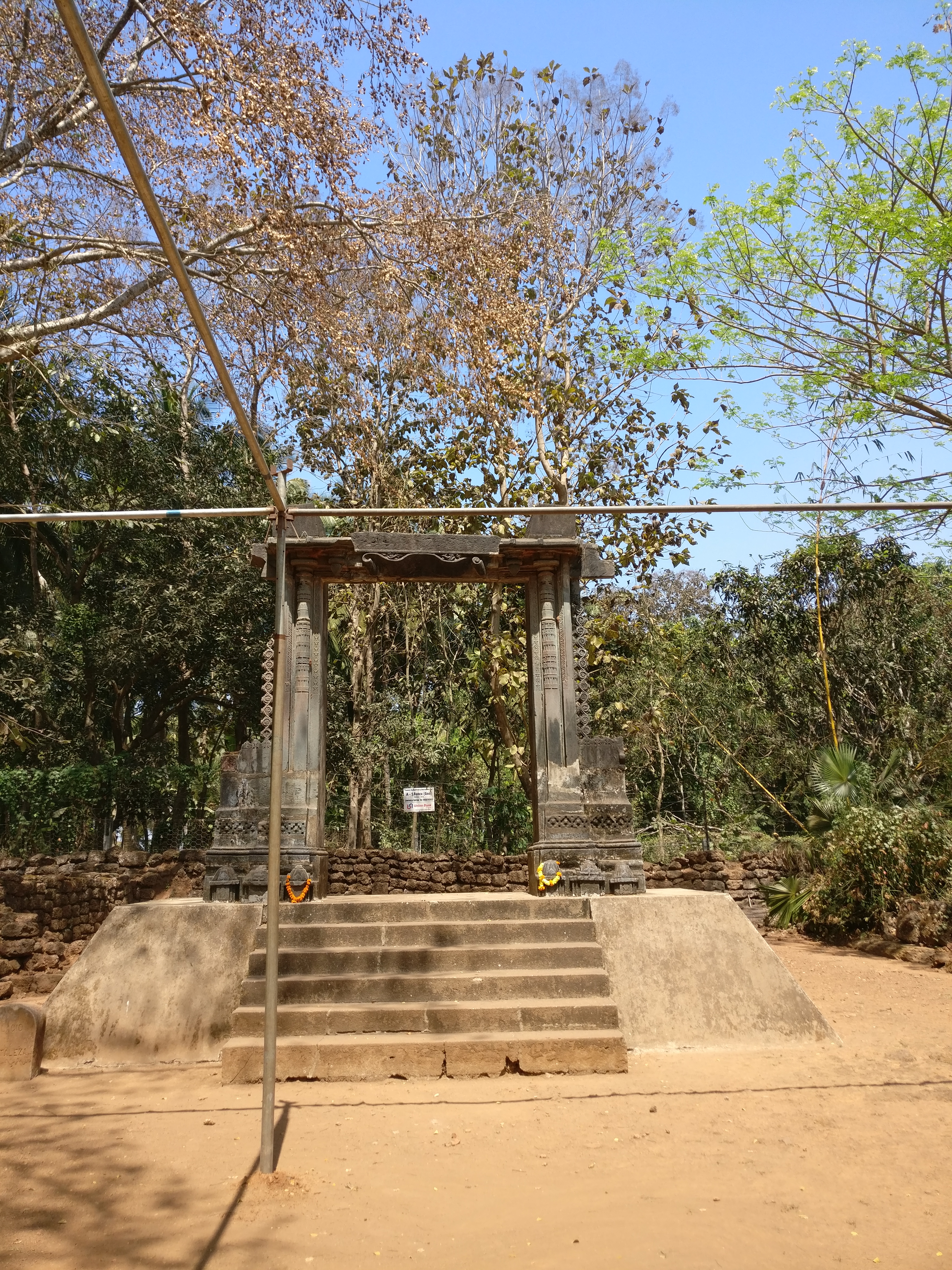
On the same grounds, as you enter the gate, on your left side, are the remains of the palace of Yusuf Adil Shah, with the main arch still standing erect. The palace was constructed just before the Portuguese took over Goa from the Muslim ruler who was ruling Goa and Bijapur in the present day Karnataka. It was supposed to have been destroyed around 1820 and the only surviving remnants are the arch and structural traces of the laterite walls around.

cajetan 3

Today, perhaps St. Cajetan Church is the only domed church in Goa. With minimum number of tourists visiting it, the premises of the church exudes a peaceful environment and tourists as well as pilgrims enjoy a quiet moment of prayer and meditation in front of the altar.

cajetan1

Bastion of the Bygone Era – Reis Magos Fort

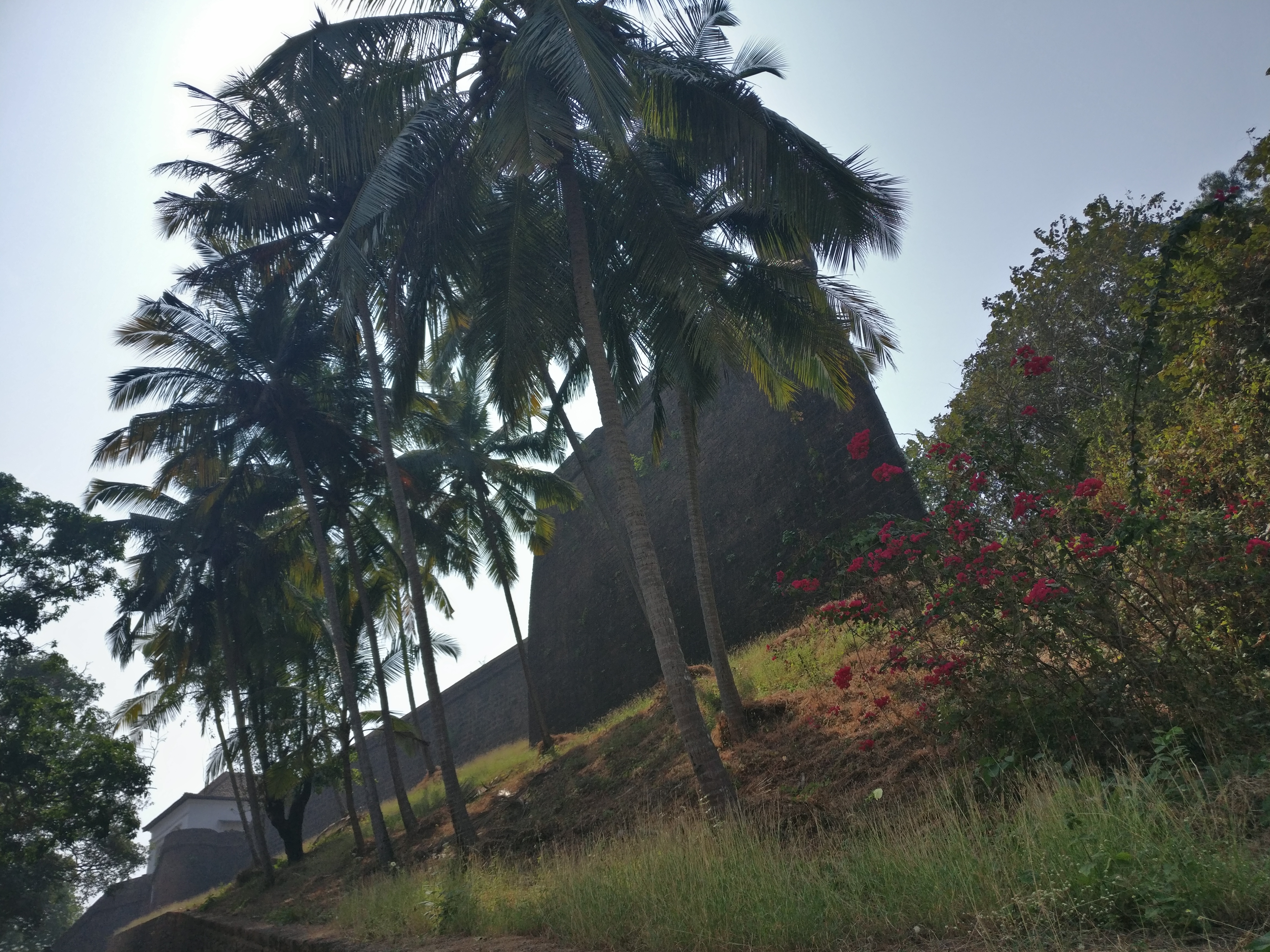
As you drive through the fishing villages of Betim and Verem off the city of Panaji, the winding and narrow streets suddenly bring you to the Mandovi river front. Gradually the view of the whitewashed Reis Magos church comes into view with the laterite stone walls of the fort just adjacent to the church. Reis Magos Fort in Reis Magos village, North Goa is one of the most beautifully restored monuments in the recent times. An abandoned sub-jail till 1993, it was finally taken notice by the Goa Government and was taken over for renovation in 2007. It was later opened for public in 2012 as a cultural and heritage monument. It is now listed under Goa Ancient Monuments and Archaeological Sites and Remains.

Reis 1

Goa was a Portuguese colony for around 450 years and was liberated on December 19th, 1961. The fort was built as the first line of defence by the Portuguese in the year 1540. It was constructed at a strategic point to prevent the Dutch from entering the waters of the Mandovi and thence to Old Goa or Ela, once the capital city of Goa. Several changes were made to the original structure in 1595 and again in 1707 to strengthen it further. Two more forts were built later in Aguada and Cabo in order to fortify their hold in Goa during the Maratha invasions. Eventually the Portuguese shifted their capital from Old Goa to Panaji and the fort was only used sometimes as a jail or to lodge soldiers in times of need. During the Goa liberation, some of the freedom fighters were jailed in the fort and later the fort continued to be as a sub-jail till 1993. Eventually in 2007 Goa Government decided to restore it and it was opened to public as a cultural and heritage monument.

reis 3

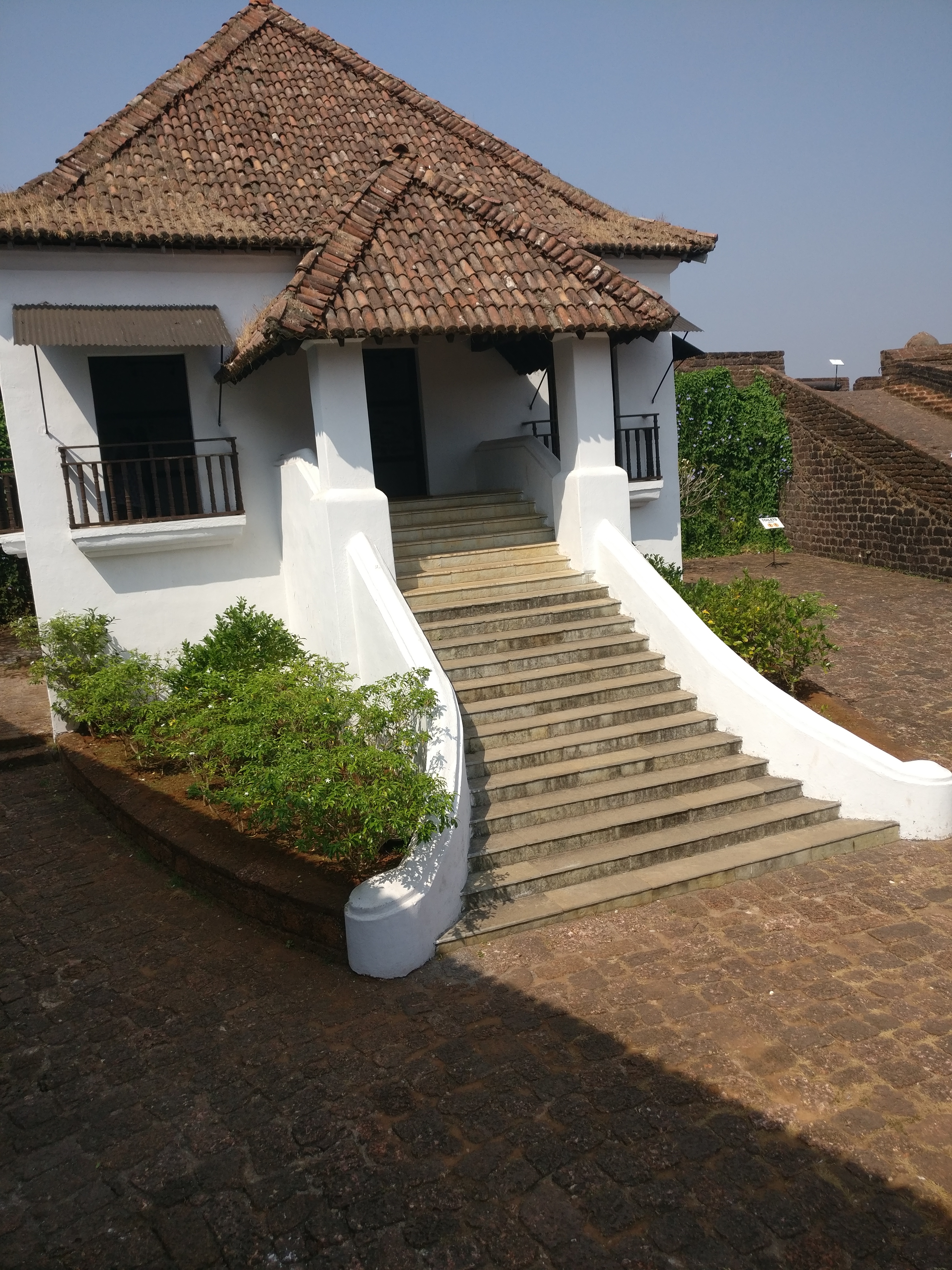
The fort stands tall today, keeping within it the stories of the people it had protected, the times it had witnessed and the wars it had fought. Reis Magos fort also houses the Mario Miranda Gallery, a Restoration hall and a Freedom Movement Museum. The most impressive aspect of my visit to the fort a few years back and again last month, was the well-kept and managed premises. You don’t see a sign of litter anywhere and this adds to the charming experience. It is now frequently visited by tourists, art enthusiasts, students and others who come here to enjoy the serenity and beauty of the place.

reis 2

The best time to visit the fort is in the morning before it is too sunny. The registration counter at the entrance provides water and beverages but once inside the fort, there is no restaurant. Make sure you wear light cottons to enjoy the warmth of the sun and the cool breeze of the Arabian Sea. The fort is open from 9:30 – 5:00 every day except on Mondays.reis 4

The fort, made of laterite, overlooks the Mandovi river and it offers a fantastic view of the river and the sea. Many of the ancient trees are saved during the restoration and they add an aura to the fort structure. Reis Magos Church, said to be the oldest church in Goa, stands next to the fort with its white-washed façade. The fort and the church make the small village of Reis Magos, a must-visit place in Goa.

The Sharpener of Knives

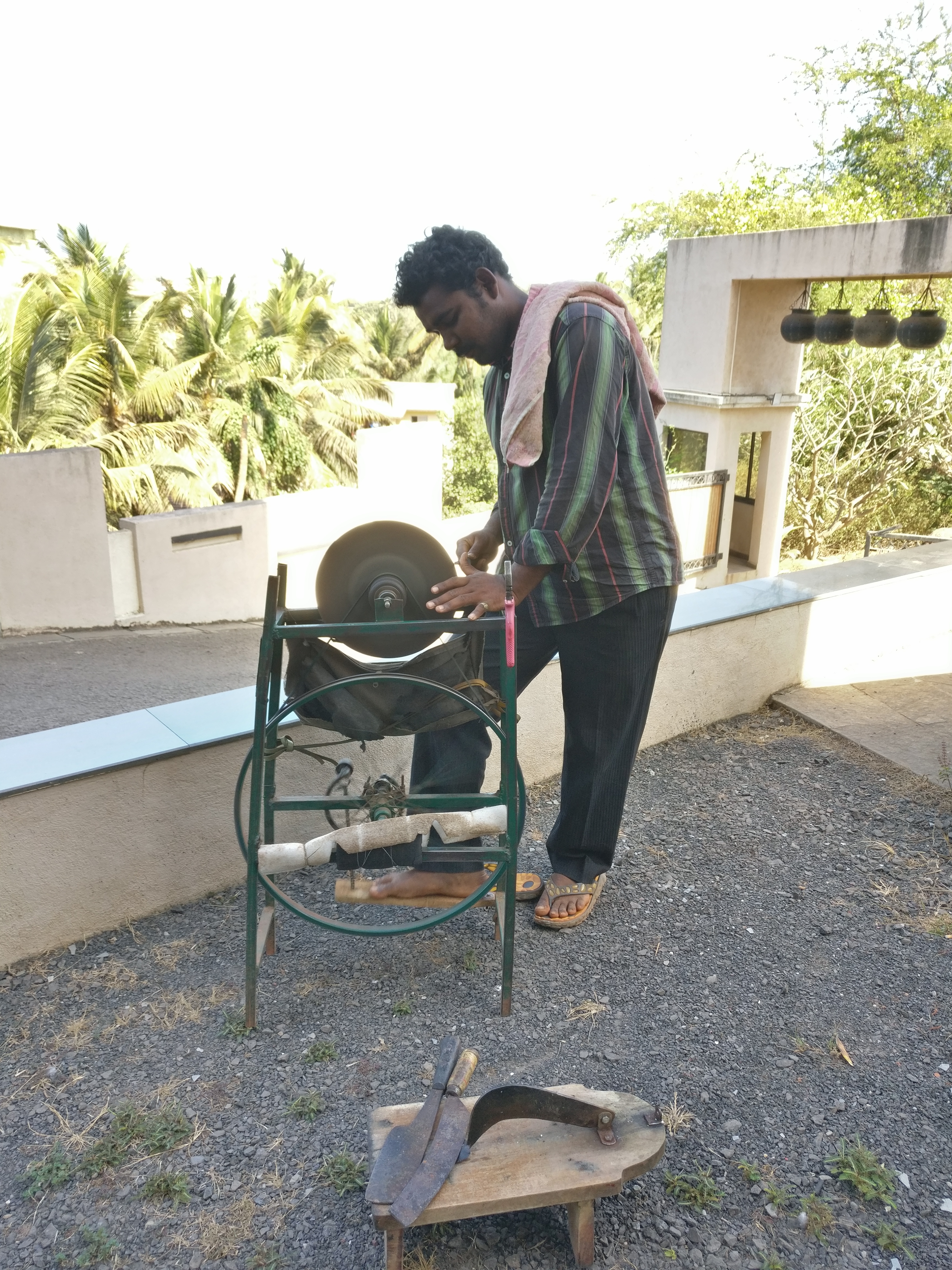
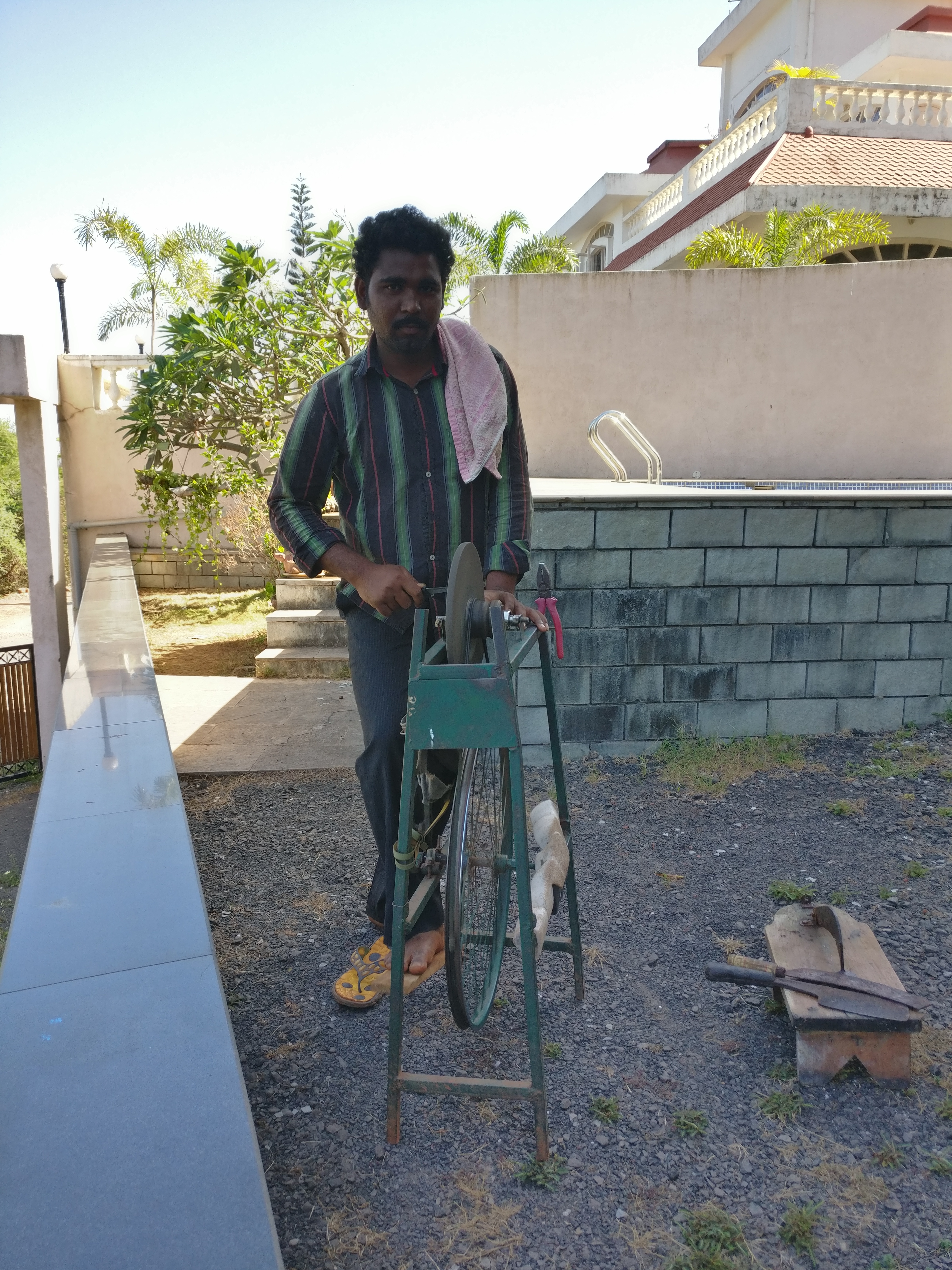
He is a frequent visitor to the residential areas of cities and towns of India, seen with his small machine hooked on his shoulder, walking the length and breadth of the Indian roads. He parks himself in a convenient place for people to notice him and starts his machine running his knife along the razor sharp edges of the circular blade. The piercing metallic sound is a call to people in the neighbourhood that the ‘sharpener of knives’ is here.

IMG_20190228_101419

I was surprised to see him this morning in our secluded and quiet colony nestled on the top of a hill. He was there just outside the gate, waiting for a householder to see him and request his services. When I asked him how he managed to walk all the way up the hill with his heavy machine, he said with a very grave, unsmiling face, “Paise keliye karna padta hai” (I have to do it to earn money), in broken Hindi. His reticent disposition did not put me off and I bombarded him with my curious questions about his life and work. A few more minutes and I learned that he hailed from Andhra Pradesh and was here in Goa for a few months every year. When he came to know that I spoke Telugu too, his face broke into a smile, and he looked suddenly relaxed as I continued to chat with him.

A middle-class Indian is usually very thrifty and hesitates to discard anything without considering its value. Knives, scissors, other domestic tools are all reused as long as they can be utilized in some way. Kitchen knives and scissors that become blunt after many years of use are stored away for the day when a knife sharpener man visits their locality. It is a common sight in India, people bringing out a bunch of blunt, rusted knives of different sizes and shapes, and getting them sharpened again. There is a joy in being able to reuse an instrument or a tool without unnecessarily spending a couple of hundreds on it.

Rangayya comes to Goa every year in the months of February-March just before ‘Gudi Padwa’, new year celebrated by Goan Hindus. He stays on till August-September and leaves back to his village Mārkapuram, Andhra Pradesh after ‘Ganesh Chaturthi’ (the Hindu festival worshipping Lord Ganesha, the elephant God). He comes here leaving his family behind in his village and goes around Panjim, Merces, Ribandar and sometimes as far as Calangute, Baga, Siolim etc in North Goa for work. He travels by the local buses, sometimes requesting the bus driver to keep his machine on top of the bus if the bus is too crowded. Rangayya claims that he makes enough money sharpening knives all day. He charges anywhere between 30-50 rupees depending on the size of the knives and their condition.

He seems be happy living the life of a nomad for a few months every year. Back in his village, he finds work on the fields as a field hand or does miscellaneous jobs around the village.

IMG_20190228_101355

My neighbour came out just then with a bunch of blunt knives and an adoli (a traditional Goan vegetable cutter and coconut scraper). A few minutes of haggling, they settled for an amount that they both were contented with and he started his work. With the piercing metallic sound deterring us from making any more conversation, I looked on quietly, watching him sharpen each knife with dexterity.

Dreamcatchers

“Oh wow you look so beautiful!! Are you a movie actress?”

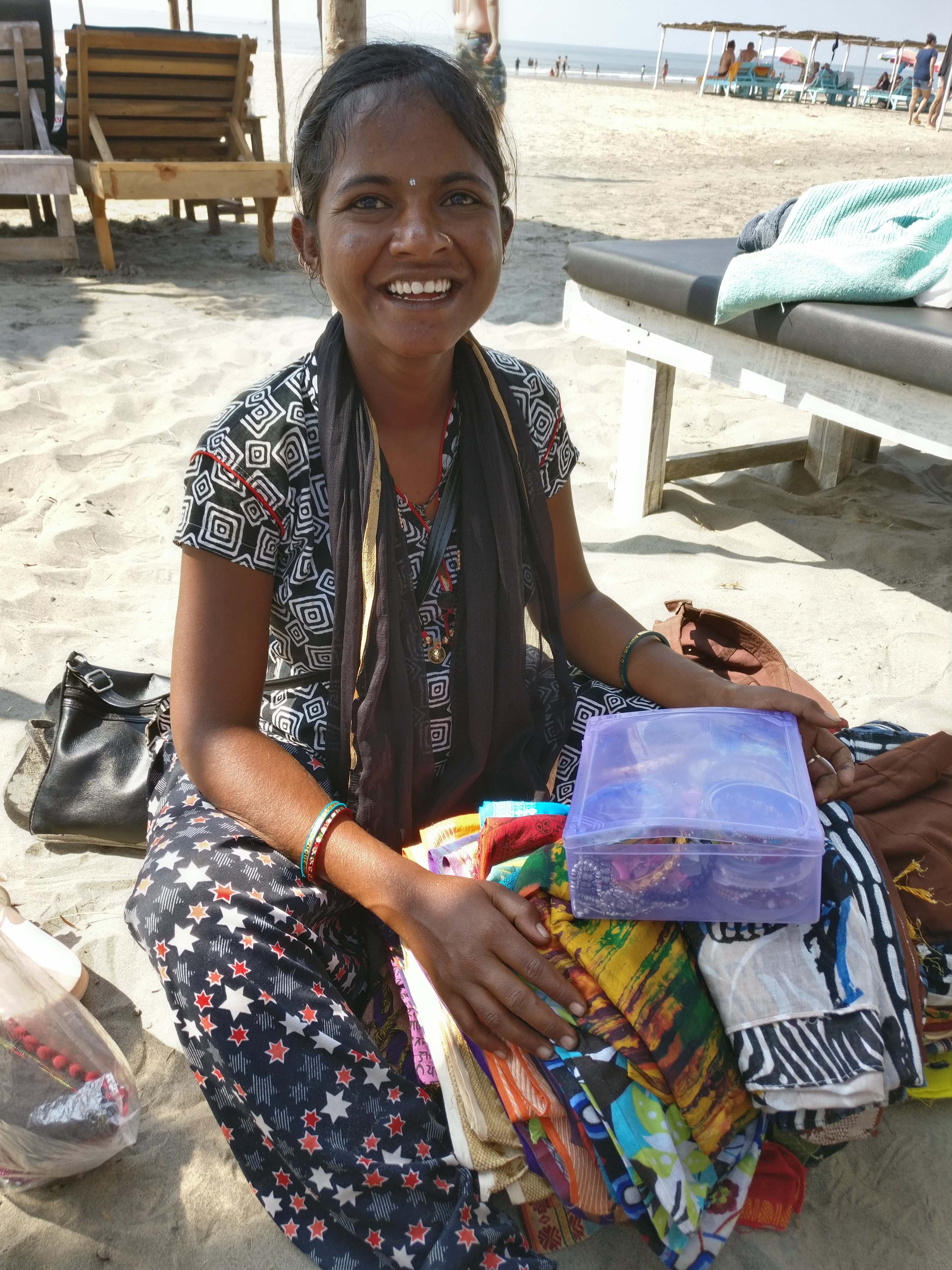
The voice woke me from my languor and I saw in front of me a 17 year-old- old girl, unloading her sacks of clothes and a box of jewellery and settling down on the sand, making herself comfortable. I was enjoying a chilled mojito on a beach in North Goa soaking in the lovely expanse of  beautiful deep blue sea.

 ‘You have such beautiful skin. I have an anklet that will look perfect on you’.

 I was amused at the casual yet bold comment of the girl and there is not the slightest bit of fakeness about her as she continued to smile and chat.

She quickly eased into a conversation with me asking me if I wanted to buy any clothes from her.

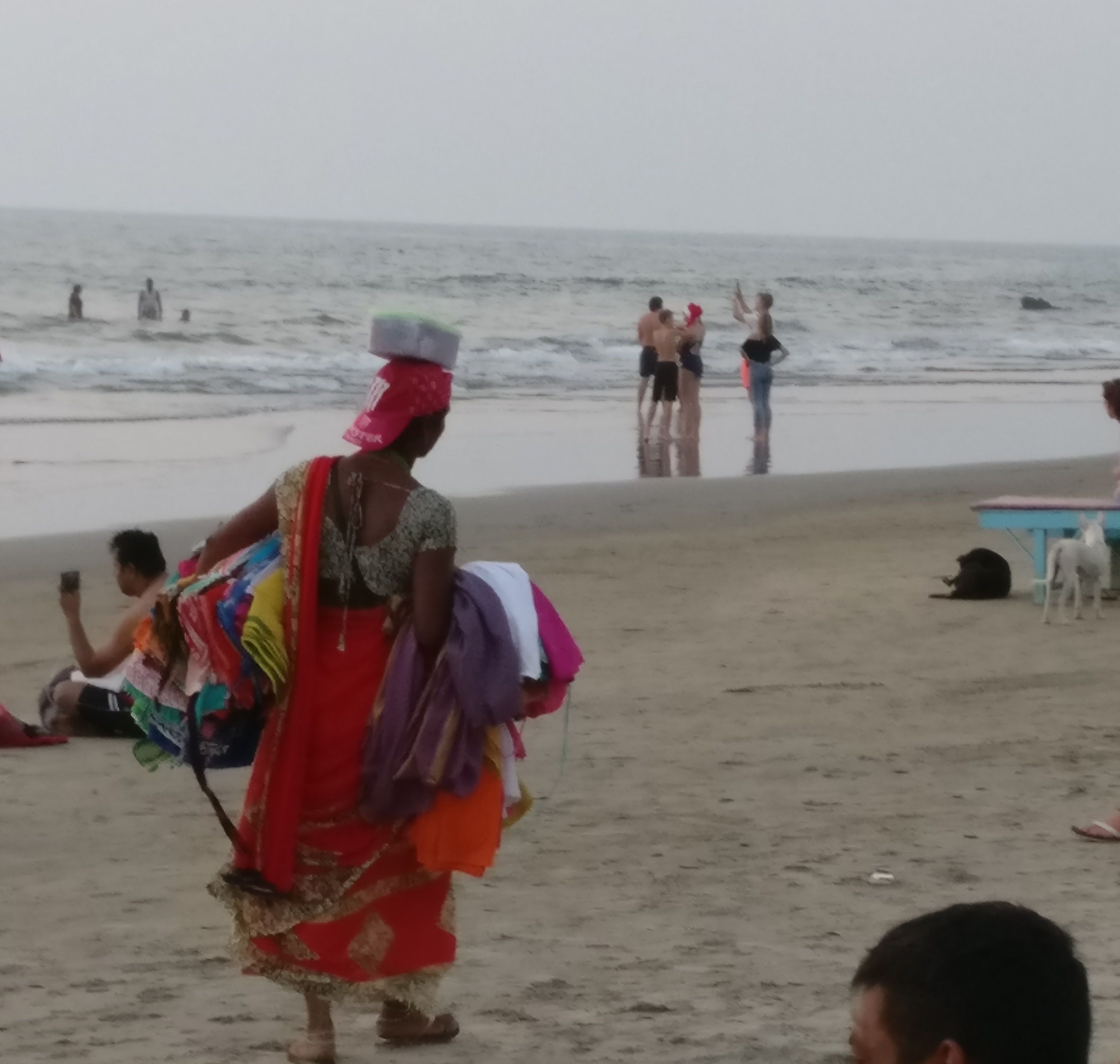
I couldn’t help but like her instantly. I was suddenly so proud that she was conducting herself so bravely in a world that is filled with harsh realities. She said her name was Anjali and she came to Goa for the first time when she was 10 years old with her friends from Hubli, Karnataka, to sell jewellery on the beach and make some money. Since then she has been coming every year to Goa and got married a year back to a boy who was also from her village. Eight months pregnant now, she walks bare-foot on the hot beach from dawn to dusk selling trinkets and clothes, making friendly conversations with the tourists in English, Hindi and Russian. It amazed me that her diction was quite sophisticated and she was very easy with striking a conversation with complete strangers in front of her.

Ashwem pics 2

Many like Anjali who come to Goa to make money as pedlars are extremely adaptable and learn a foreign tongue within days. They move from one place to another, sometimes avoiding the watchful eye of a police constable, who makes it his responsibility to drive these hawkers away from the beach. ‘We give him a few hundred rupees and he leaves us alone”, laughs Anjali, sharing her secret.

Ashwem pics 3

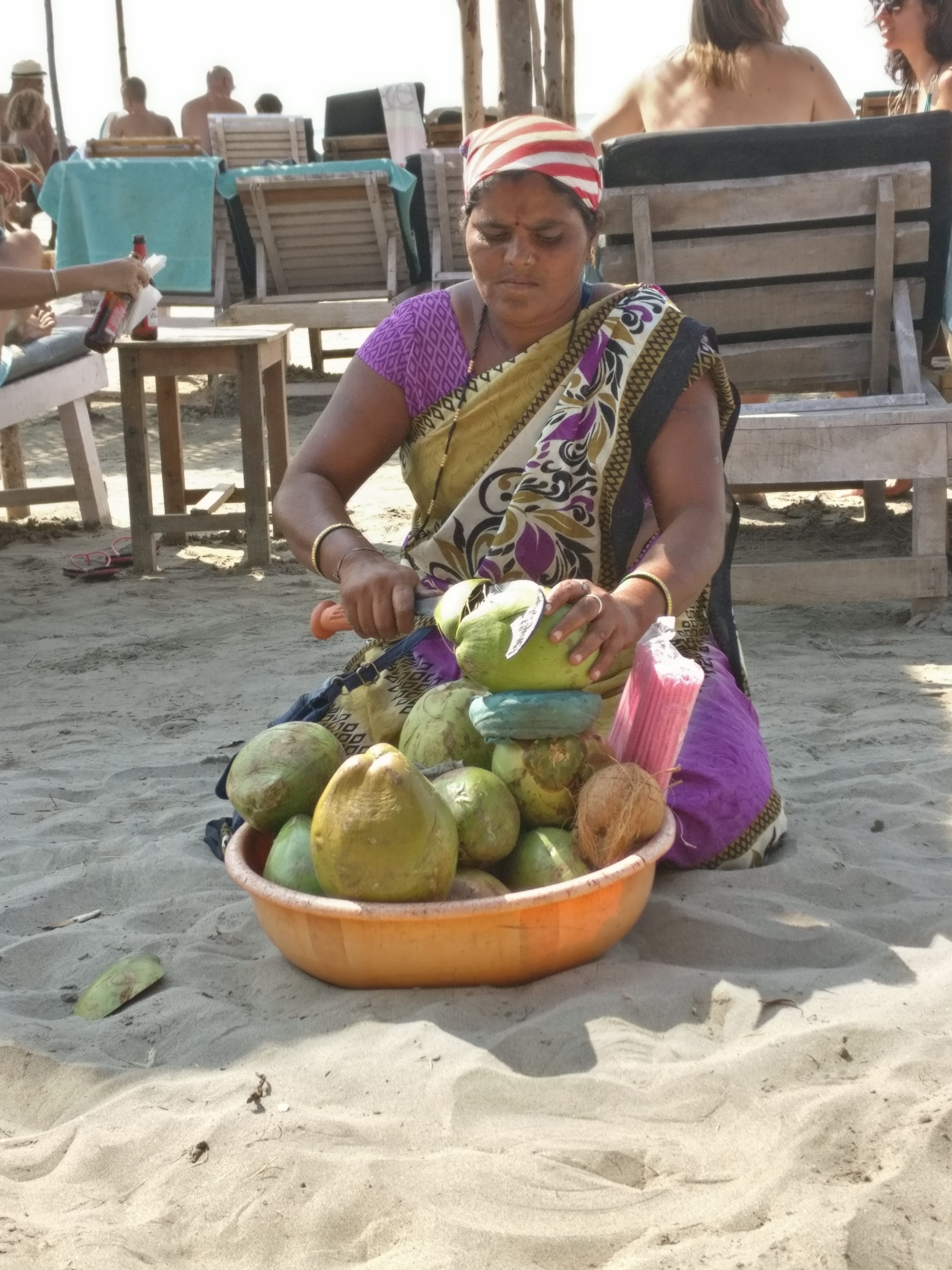
As I was engrossed in conversation with Anjali and trying out anklets and bracelets, Pushpa, a friend of Anjali, approached eagerly to sell her wares, hoping to convince me in to buying a few baubles from her too. Sarita, a close friend of Anjali, makes quick buck selling coconut water on the beach every day. Another lady goes around giving head, neck and foot massages on the beach. All of them come every year to Goa during the tourist season from different parts of Karnataka. They stay from October – March, make a little money and go back to their native place by the end of the season. The rest of the year they work on the fields as farm hands. This year Anjali and Pushpa, (who is also seven months pregnant) plan to go back early to their native place, in time for their delivery. With an unpredictable future in front of them, but undaunted by the huge responsibility on their shoulders, these ladies look happy and contented with what they have and seem to take life in their stride and live for the moment.

ashwem pics1

“I feel very happy talking to you didi  (‘sister’ in Hindi). Please wish me luck. I am going to have a baby,” said Anjali with a broad smile of her face, as she picked up her sacks and turned around to talk to another prospective buyer.


A Feminist Manifesto


“The knowledge of cooking does not come pre-installed in a vagina. Cooking is learned. Cooking is a life skill that men and women should both ideally have.”

These are the words of the Nigerian writer, Chimamanda Ngozi Adichie in her book “Dear Ijeawele, or A Feminist Manifesto in Fifteen Suggestions”. The book was born when a friend asked Adichie for her advice on how to raise her baby girl, Chizalum, a feminist. Adichie puts together a simple list of invaluable suggestions for every woman and every girl to become more empowered and independent. She highlights some very basic choices that a woman makes in her life, some out of ignorance and some because of societal norms and pressures. Decades of conditioning has made the society assign lopsided roles for both men and women in domestic as well as workplace scenario. Adichie’s list is a gentle reminder that gender roles restrict to only biological necessities like giving birth or breastfeeding a baby and all the other duties and responsibilities are necessarily not just a woman’s.

IMG_20190126_173239


IMG_20190126_173314

I can relate to several instances that she brings up in the book well as many African traditions, customs and social norms match those of Indian. While in Indian context there has been a massive change in the last couple of decades, there is still a large part of the country both in urban as well as rural areas where the subtle gender expectations still exist.

I remember some years ago, when an aunt and uncle were discussing ‘prospective’ brides for their son, they approved of girls from certain districts of Andhra Pradesh but not from certain others. The reason for disapproving girls from those areas was that girls who came from so and so district were very ‘powerful’. A little research revealed that people from these districts were landholders and were hence well educated and women usually owned properties and they were very good with financial decisions at home. Hence there was an imminent threat that they would ‘overpower’ their husbands hence making them ‘hen-pecked’. But if you ask me, these are characteristics of an excellent, skilled and talented woman who, if given an opportunity, would take care of the family successfully. The couple would raise their sons and daughters with equal status. But conditioning makes us feel uncomfortable around any woman who is strong.

I have witnessed over the years similar family conversations that surround the son ‘allowing her daughter-in-law to work’ or ‘We gave our daughter basic education. After her marriage, it is up to the husband to let her continue or not’ or ‘Oh! My son is a very busy doctor. He wants a wife who can take care of home and children’ and the like.

When we were growing up, somebody or the other in the family would advise my mother, “Don’t let your girls choose whatever they want. Some decisions are for parents to make.” Well, if it is only about choosing a school or picking which movie you want to go, it is not dangerous. But if the choice is about who you want to marry or what career you want to choose or whether you want to work or not, the choice HAS to be yours. And thankfully our parents seldom interfered in our lives.

Adichie’s manifesto throws up many such instances which are from a domestic setting and workplace, prejudices expressed through vocabulary, cultural connotations, gender manifestations etc. Her advice to her friend (and all of us with daughters and sons) ranges from personal choices women should make for themselves to the necessity of financial freedom, respecting culture and traditions selectively and teaching her daughter the importance of reading books.

Adichie’s style is very unpretentious, assertive, gentle and evocative. The language is simple and straightforward and the book opens up a series of thoughts and experiences from your own life. Her advice is simple and does not encourage, suggest or express authority or control in the name of gender but simply reminds every one that we are human beings and everyone is entitled to his/her freedom.

The Fragrance of a Jasmine


Summer is the time jasmines (malle in Telugu) flood the flower markets in South India. It is a busy and prosperous time for the flower merchants in every town and city and these beautiful, fragrant flowers adorn every occasion in every home. Malle has an important place in Telugu weddings. They are used for garlands of the bride and groom, to decorate wedding altars, and, not to forget, for the bride’s poola jada (plait adorned with flowers). I know many of my friends who got married during the months of April/May, daring the sweltering heat of summer, just to have loads of malle for their wedding.

IMG_20190119_155754

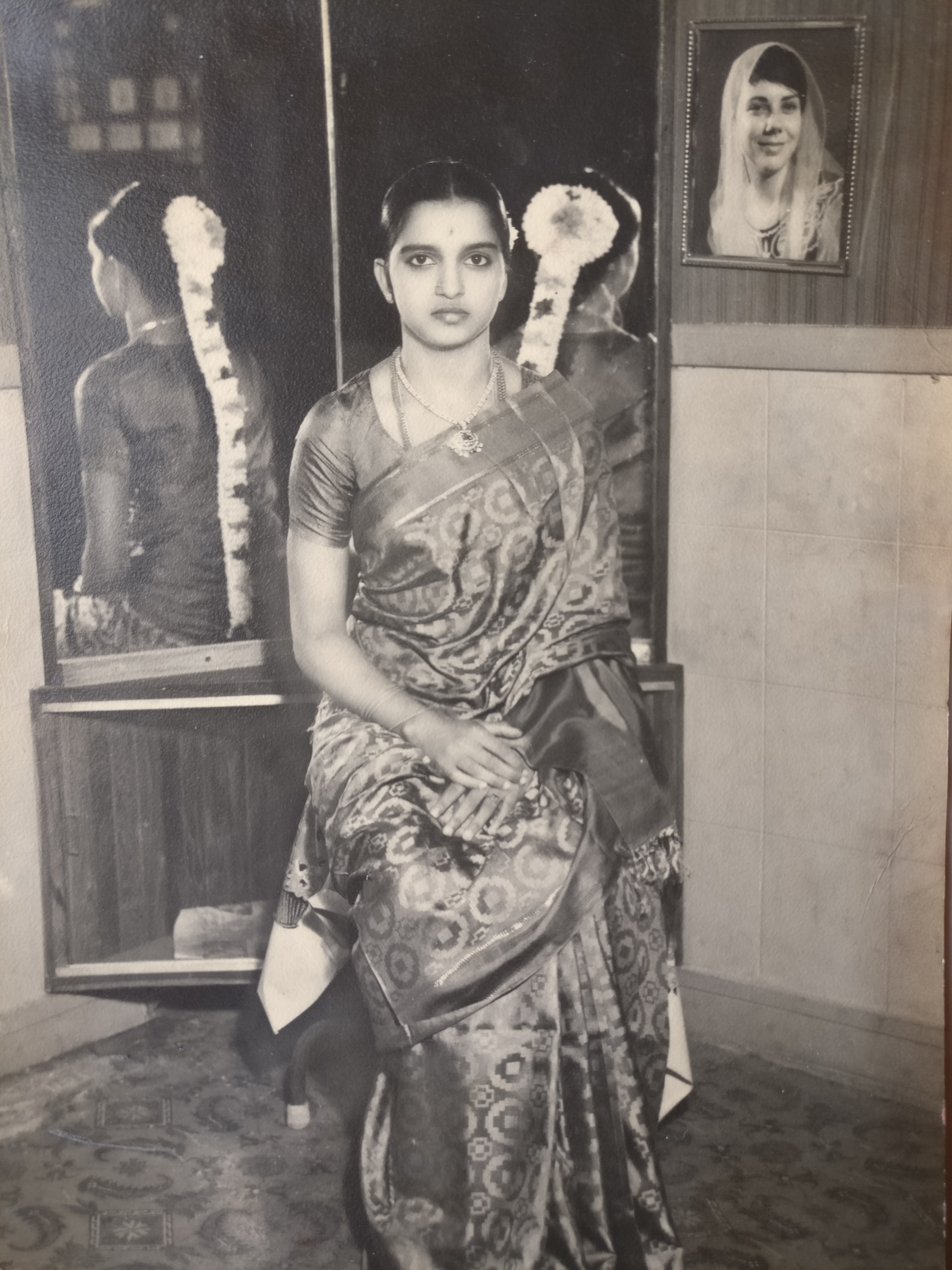
                                  My mom Savitri a few days after her wedding (1962)

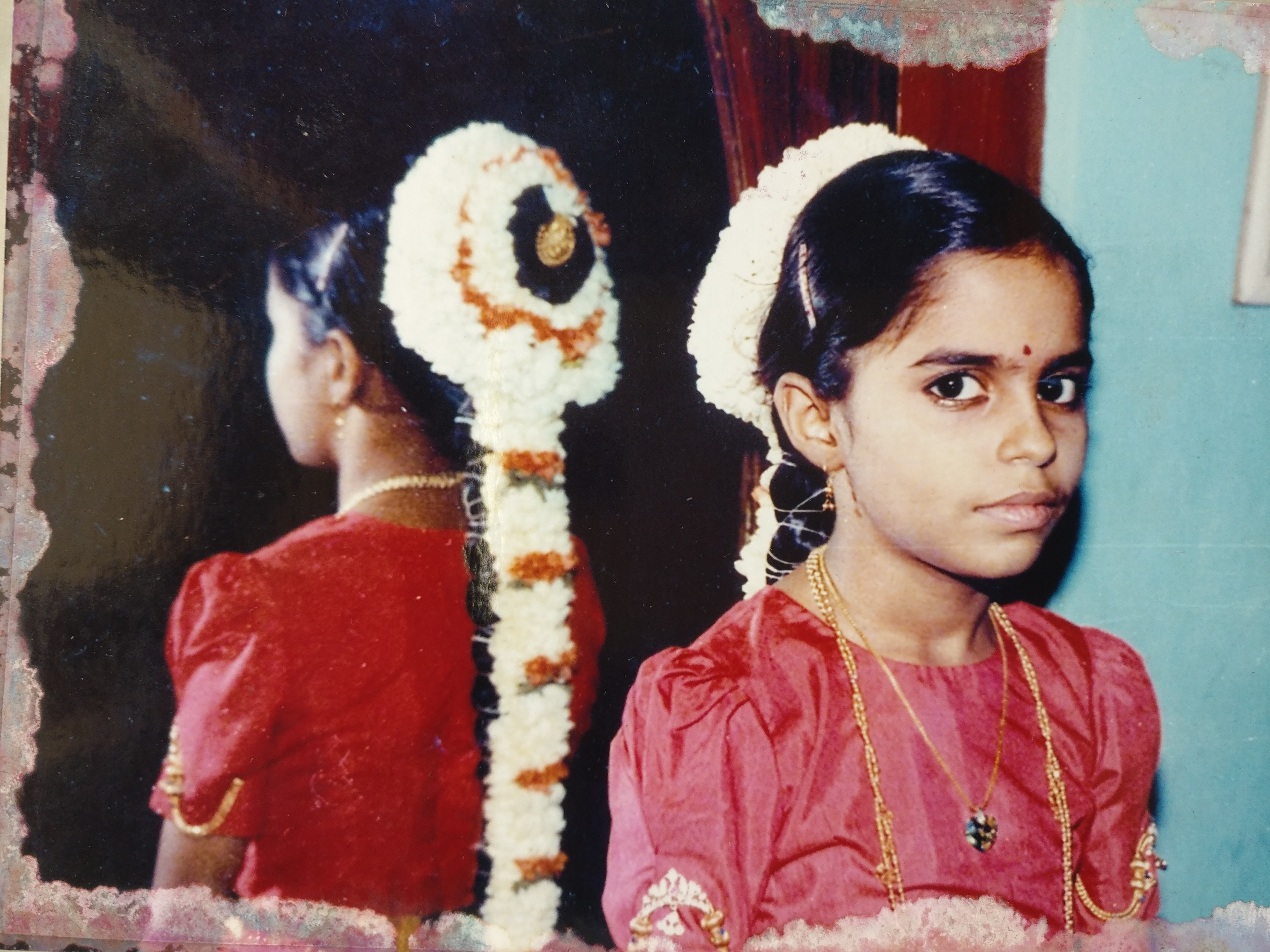
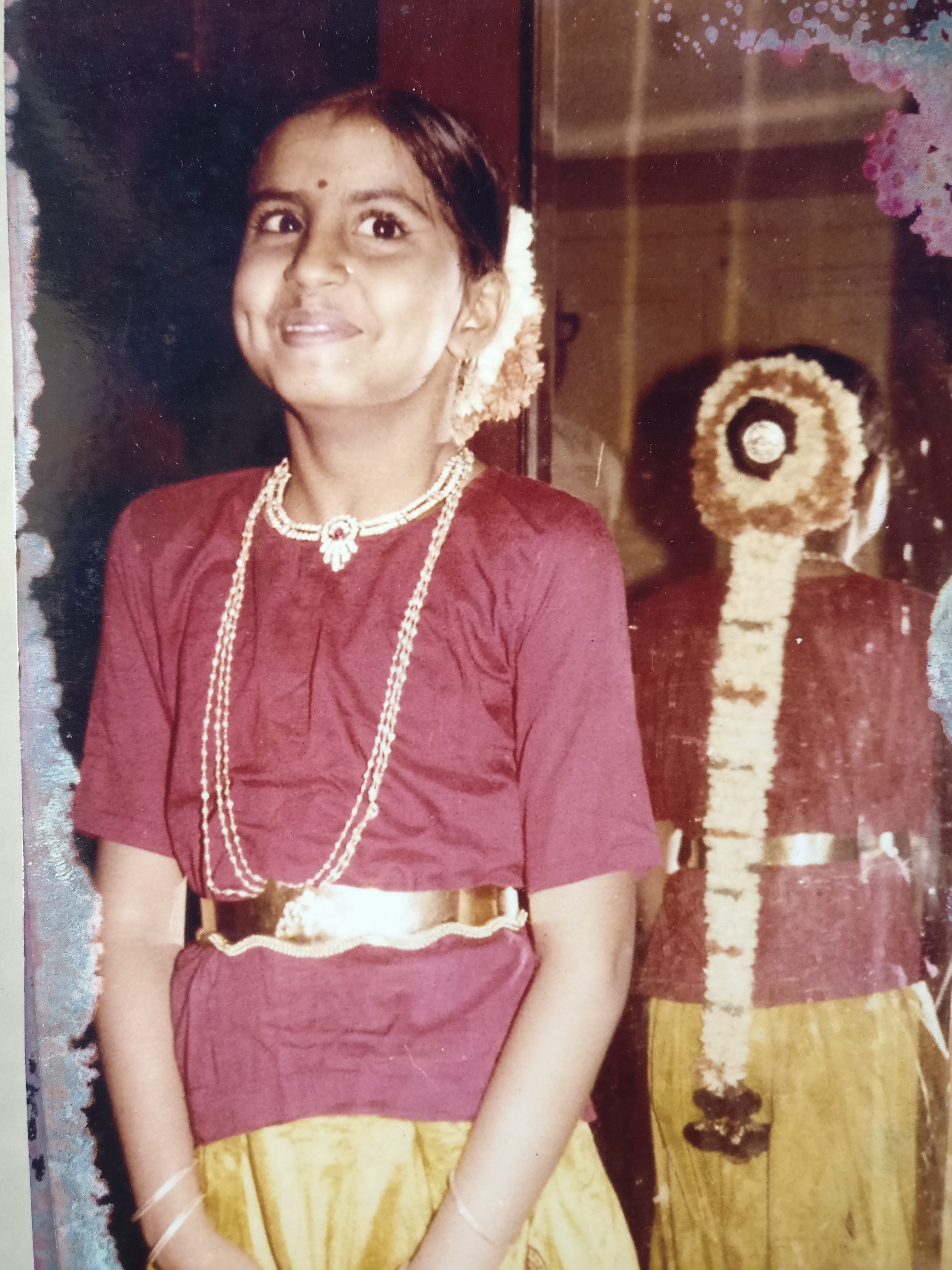
A few days back I was going through my childhood pictures and my daughters were fascinated with pictures of my sister and me with a poola jada and dressed in traditional attire of pattu parikini (a Kanjeevaram long skirt and a blouse worn by girls on festive occasions). It was almost a ritual during summers to get a flowered plait done at least once. Every summer, my mom would set a date for us to get the poola jada done using the malle flowers that were abundantly available in the market. The program involved meticulous planning and my mom took it very seriously. One particular variety called boddu malle was very popularly used for the poola jada. My brother would be sent to the local flower market in Vijayawada to meet one particular vendor for the ‘best’ boddu malle buds for that perfect jada. He would buy a couple of kilos of them early in the morning. Then my mom would inform a lady who was a distant relative, who specialised in the art of making poola jada. The lady would arrive post lunch and then the important task would start. She was treated with utmost respect and everybody in the house danced attendance around her serving her coffee and snacks and generally keeping her happy.

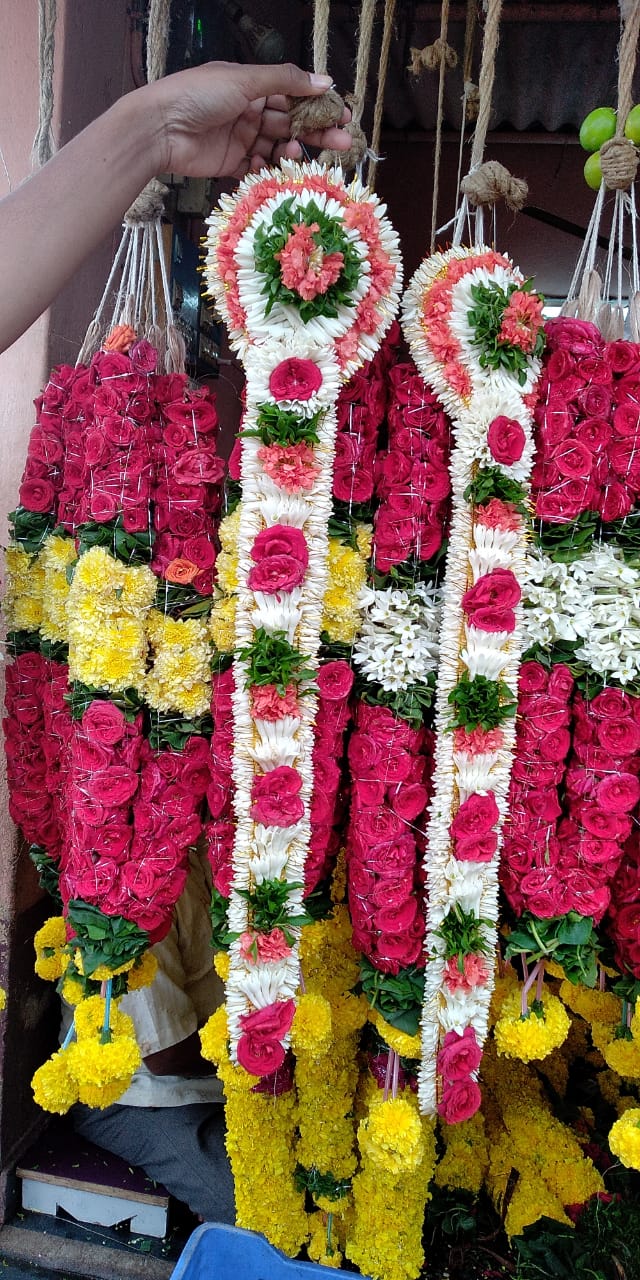
If you ever harboured a fascination to have a poola jada made for your hair, one absolutely essential criteria was to have long, thick hair – ‘long’ because the poola jada would not look good on short hair; ‘thick’ because if you had thin hair, you would end up with a terrible headache owing to the weight of the poola jada. For those who had neither of these, a hair extension was used to make the plait look longer and thicker, with several knots and elastic bands all along the plait to keep it in tact. Today, as a matter of convenience, ready-made poola jadas are used for brides and flower vendors take orders even a few days before the wedding.

IMG_20190119_155812__01
Posing her best, my sister Aparna (circa 1983)


The making of poola jada involved several hours of patience and concentration. First our long hair was neatly plaited till the end which was then adorned with a hair accessory called jada kucchulu (an accessory used to enhance the beauty of the plait). Each malle bud was selected with care and with the help of a white thread, the buds were made into garlands. These garlands, made in different lengths, were then sewed into the plait right from the top of the head and along the length of the plait, carefully tucking away the flowers into beautiful designs. Sometimes other varieties of flowers in different hues like roses and kanakāmbara were used along with malle for added beauty. The lady would take a couple of hours for each of us which meant the entire episode went till 7:00 in the night.

The activity didn’t end there. After the poola jadas were made, my mom would make us wear the traditional pattu parikinis and the gold jewellery while my dad or grandfather would get ready excitedly with their camera, ready to capture the moment. I remember my sister and me grumbling all along for the silliness of the situation. The only fun part of it all was the fuss the elders made around us. We were suddenly treated with a lot of importance and we were fed dinner by my mom or an aunt, narrating a story or two to divert our attention from the discomfort. Bedtime was an agony with capital ‘A’. Lying down on the bed, with the poola jada carefully placed to the side, we spent the rest of the night in just one single position and invariably woke up in the morning with a stiff neck and bleary eyes from lack of sleep. The poola jada lasted the entire day and we would have a dreadful time taking bath and generally going around with the heavy thing following us everywhere.

IMG_20190119_155824
Me, super amused with my attire (circa 1983)


I remember a couple of weeks before school closed for summer, some girls in the school would come with poola jada and school uniform to go with it!!! It was a common sight in school during the pre-summer-days and teachers didn’t mind girls coming with mehendi designs on their hands, heavy silver anklets over their school shoes or flowers in their hair along with black ribbons.  It was a sight to behold!!

IMG-20190119-WA0031

Ready-made poola jadaas (image courtesy: Valli, my friend from Vijayawada)

I must confess here that my sister and I never actually craved to be part of these occasions since it would only mean two days of discomfort. We would just find ourselves in the middle of one every year, because the fun and amusement derived from these gatherings were purely for the adults, who absolutely enjoyed such occasional digressions from their routine life. But over the years, the nostalgic person that I am, I find the experience really unique and a significant part of growing up, carrying with it the essences of the bygone days.