
Can’t We Talk About Something More Pleasant?

Conversations related to the inevitability and permanence of death are considered ominous and are often avoided, postponed or in many cases, ignored. We pretend that old age and death are non-existent and even a mild reference to them upset us. People are generally reluctant about writing a will, saving up for unforeseen illnesses or even letting go of things.
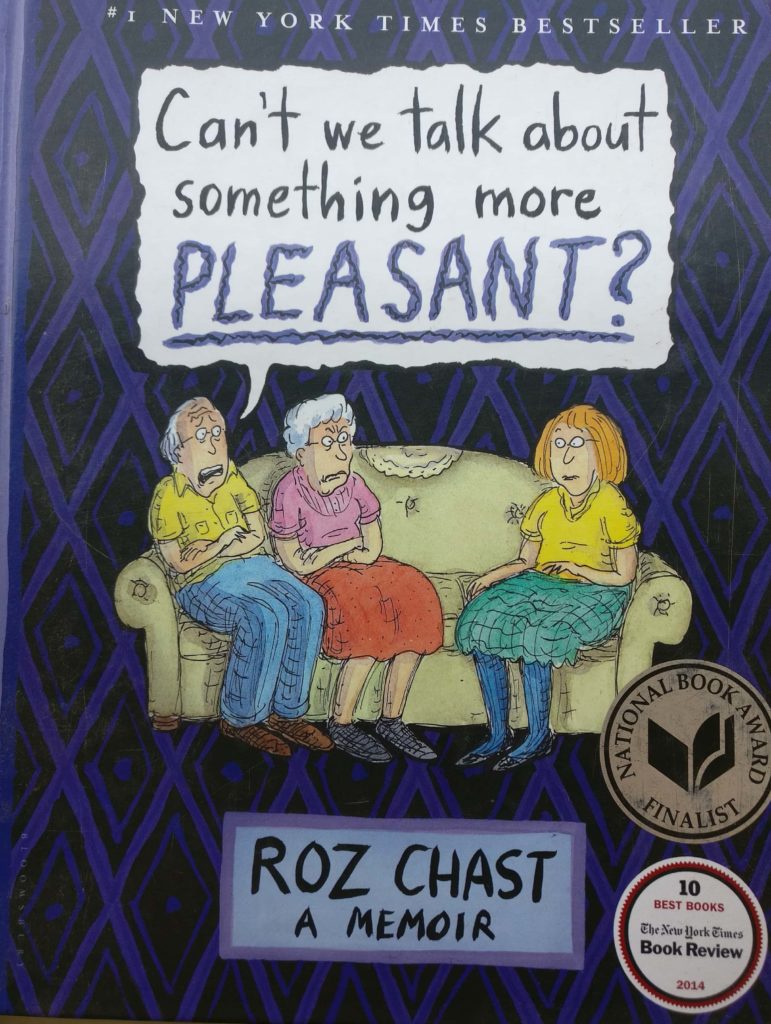
In “Can’t We Talk about Something More Pleasant”, Rosalind “Roz” Chast recounts her personal experiences with her elderly parents while taking care of them during the last few years of their life. Roz Chast, a New York journalist and cartoonist, narrates vividly her observations and her experiences taking care of her parents in Brooklyn. Her Jewish parents migrated to United States at the turn of the 19th century. George Chast, her father, was a high school Spanish and French teacher and her mother, Elizabeth was an assistant principal in an elementary school. They worked hard and lived a very humble, frugal life. Chast, their only daughter, after she moved out of her parents’ house, withdrew from any involvement with her parents for several years, till one day she dropped in their apartment for a casual visit. Her visit throws her in to a sequence of unavoidable responsibilities that she doesn’t expect and draws her into the life of her parents who are by then well into their old age. Chast’s memoir takes you through her bitter-sweet journey with her parents, especially during the last decade of their lives.

The memoir starts with Chast’s concerns about her parent’s future and the conversations she has with them which they tactfully avoid answering. Chast puts this into perspective and draws the title of her book from the general reluctance that people exhibit with subjects like death, old age and even religion. Chast sums it up in the “Introduction’ with a statement “Maybe they believe that if they just held on to each other really tightly for eternity, nothing would ever change”.

What is refreshingly different is Chast’s perspective about eldercare. In a world where taking care of one’s parents is highly romanticised, Chast’s very straightforward narration puts you off balance. The first two pages set the subject matter in place and then what follows is a sequence of events that unfold in each page, through her vividly descriptive cartoons, sketches, notes and photographs. Each cartoon abounds with visual as well as verbal expression and as she fills the pages with her humorous and descriptive details of her life with her aging parents, you are left with sketches and images of your own similar experiences with your parents or a member of your extended family. It is hard to judge Chast for her tempers, her occasional outbursts and her reluctance once in a while dealing with her parents. Moments of frustration are soon washed over by her extreme love for them and concern for their well-being.  The memoir takes you back and forth between the present episodes and her childhood recollections. Chast is very candid in her descriptions of some embarrassing moments during her teenage years growing up with her parents, the shabbiness of their house, her mother’s tantrums and her father’s anxieties. She doesn’t mince her words when she describes her helplessness whenever she found it too frustrating dealing with her parents. She takes her readers down the memory lane, from revealing her life as a shy introverted kid to being an unhappy teenager, growing up in Brooklyn. She describes her parents as hardworking, loving and very humble about their living conditions. As parents who have seen the Great Depression, they instilled in her the lessons of frugality. But what Roz remembers the most was her parents’ indifference towards her needs and emotions. Her mother, throughout the memoir, is shown as a having ‘fearsome temper’ which she called ‘blasts from Chast’. In the book she describes her father as ‘tentative and gentle’; her mother as ‘critical and uncompromising’.  While her mother made all the decisions at home, including those of Roz’s personal choices, her father merely accepted his wife’s decisions and succumbed to them. It was always a gruelling task to persuade her mother to see a doctor, even in case of a medical emergency as she had an aversion to doctors and hospitals. She was often heard saying, “I am built like a peasant”. She refused to give up on life and kept her husband afloat too as she battled with her aging body and the ticking time. Her grit and determination to fight death was phenomenal and it is very easy to see how the couple was perfect for each other – Elizabeth, strong and determined; George, frail and submissive. But Roz Chast is very candid about her parent’s feelings for their only daughter and their own love for each other.
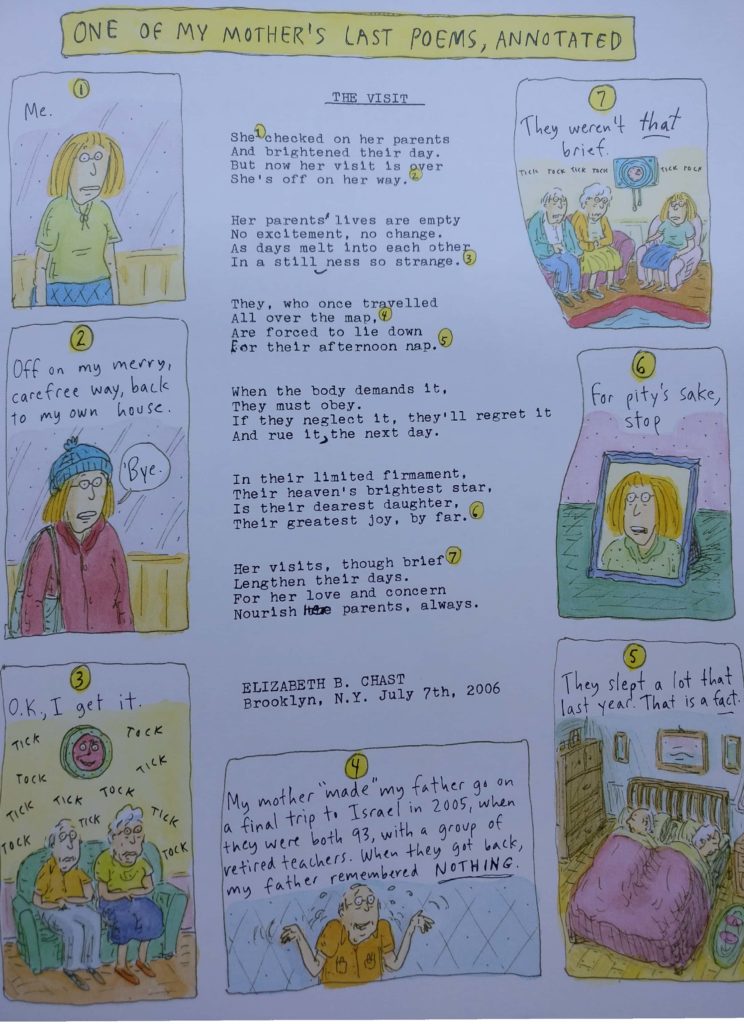
Roz’s memoir is interspersed with emotions, positive and negative, which well up in her as she takes care of her aging parents. Living in Connecticut, she would make frequent trips to Brooklyn to either spend time with her parents or rush them to the hospital whenever there was a mishap or emergency. The latter increased as the years pass by, which persuaded her to make a decision to keep her parents in assisted living facilities. She soon realised that convincing them to live in such homes was not easy either as her parents found them a ‘hell hole’ and detested the fact that they were not called ‘residents’ but referred to as ‘inmates’. With myriads of complaints and inconveniences, accompanied with rapidly dwindling finances(a fact that her parents were happily unaware of), Chast and her parents swim through their days, assisted by hospice care, nurses and the staff of ‘the Place’.

With senility at its peak, dementia, aging bodies and dwindling mental faculties, George and Elizabeth stand for their ilk, who take things in their stride, with the will to live on their own and a hope to survive against all odds.

Once Upon a Summer Day

Māvichiguru tinagānē…koyila palikena…”

(Soon as she eats the tender buds of mango, the koel sings…)

The famous Telugu song of yester years stirs my soul. I lay languidly on the couch, entranced by the effect the song has on me. I drift dreamily into the idyllic days of my childhood…summertime. Though I hail from one of the hottest places in India, Vijayawada, I don’t have any memories of discomfort because of the heat. With the temperatures hovering between 45 – 49 degrees, it was pretty easy to succumb to a heat stroke. Sans ACs, sans cold drinks in the refrigerator, the summer vacation would pass amidst fun, frolic and two months of absolute bliss. But thankfully my granny always had a vessel full of buttermilk ready and we kids were encouraged to drink a lot of it. It was that part of our lives when we were living in our ancestral house, the headquarters of our family network. We would look forward with almost a painful impatience for the annual exams to get over and the vacation to start.

Watching the mango trees in our yard go through their seasonal changes was fascinating. The fragrance of the flowers in full bloom assured us that summer was ‘just round the corner’. The heady essence of the flowers in the air would leave us pining for summer holidays. The flowers finally gave way to tiny buds of green tender mangoes for which we fought with equal fervour along with the greedy parrots and the ‘innocent’ squirrels. The elders’ repeated warnings against eating the tender mangoes, seldom had any effect on our strong determination to eat them. These episodes were soon followed by sore throat sand coughs and would temporarily make us ‘repent’ our stubbornness. But a couple of days in bed, we would be up again, back to collecting tender mangoes fallen under the trees.

The rising temperature also brought with it the most eagerly-awaited summer activity – making pickles. My fondest memory was of the sheer excitement of the family members voluntarily involving in the process of pickle making. My grandmother, the head of the family (and the keeper of the secret family pickle recipes), would make a few quick calls to the local grocer for the required spices (chilli, mustard, fenugreek). While the men were involved in the more laborious activities of plucking the mangoes, washing and skilfully cutting them into surprisingly similar sizes, the women got busy with the drying,grinding, measuring and mixing of the spices with the cut mangoes and oil with precision. And finally it was time to taste. First the fresh pickle was mixed with the right amount of hot, steaming rice, with a generous amount of ghee added to it. The rice was then blended uniformly taking care that each grain of rice is well coated with the red pickle before it was ready for tasting. We would feel amused watching the adults judge each mouthful with a groan or grunt and comical expressions of rolling up their half-open eyes or twisting their mouths 360 degrees before they proclaimed whether their effort was successful or not.

While the grown-ups were busy with the seasonal activities of making pickles, papads and desiccated vegetables, we kids would make cunning plots to steal salted mango pieces from the terrace, where they were laid out on transparent plastic sheets for drying. A couple of successful attempts would increase our greed for more and one of us would fall prey to the ire of the cook or my grandmother. But much to our delight, after a few ‘scolds’ from both the women, we would end up getting a handful of mango pieces as a double treat.Years later my grandmother confessed proudly that the joy of making pickles wouldn’t have been as memorable if there were no mischievous children pestering her all the time.

Summer vacation brought home a bunch of cousins from other parts of the country. There was a silent understanding between the boys’ gang and the girls’ group to stay away from each other’s mischief. While the boys tried hard to ignore the girls, they would finally give in to our jollier and more entertaining activities that we indulged in with our constant innovative games.One popular pastime was to whip up interesting ‘recipes’ in our miniature cooking set (we had a box-full of these). We would make plans even before the start of the vacation to collect a little money and stock up on ingredients such as honey and phutana dal while sugar, rice, and dal were supplied reluctantly by my mom. And the magical ingredient to anything we whipped up were the good old baby mangoes. The boys, noticing that playing with us was more profitable, would be eager to help us and sometimes were employed to steal stuff from the kitchen for our ‘gourmet’ cooking. The result of all this excitement was when we had to taste our concoction. While most times we ended up with a fabulously tasty preparation, on the rare occasions when the cooking indeed went horribly wrong, we would each try to desperately gulp down the retch that threatened to spill out.

Sleeping on the terrace was another exciting part of the vacation. With the floor of the terrace heated up during the day enough to fry an egg, in the evening we would try to cool it down with buckets of water poured on the floor.The hot ground steamed with the touch of cool water and soon, with a few more buckets of water, the floor was ready to be used for our post-dinner activities. Dinner at 7:00 was soon followed by setting the stage for our mini-theatre. The older kids in the gang always got to choose the themes and plots of our plays. Then they would carefully decide who would play which character. With a few last minute alterations, we were ready with our parts and so went the evening amidst squeals of laughter and excitement.

Now far far away from those times, summer still tickles me with the same eagerness and pleasure it always did. With two daughters at home, the excitement that summer vacation brings with it has not changed at all. Our pretend plays and fun times with cousins are now replaced by my kids’ summer camps, sleep overs with friends and a constant stream of summer parties; I relive the moments of my childhood with the same childish fervour.

As I gaze out of the window enjoying the cacophony of the squirrels,koels and the chattering parrots perched on a thick branch of a mango tree, I couldn’t  help notice a quick mischievous wink by the koel, singing what I thought was

“Gunnamaamidi kommameeda…” (On the branch of a ripe mango tree…a popular and old Telugu film song)

This is how it began…

It is very easy to lose perspective amidst the cacophony of life around you. There are times in my life when a simple solution to a simple problem seems like an ordeal, only because I am too engrossed with the clamour in my mind and my own preoccupations. Writing helps me find that fresh energy with a fresh start on a new day!

As an English teacher working in Goa, I love the buzz of a college and the cheer of the young adults I work with. There are many things that I learnt from them over the years – their infectious zeal, novelty and the passion for life they carry with them, their seize-the-day and live-in-the-moment attitude and their undying optimism. I am inspired to do just the same.

I live in the past, savour the present and excited about the future. This is my space to share stories of people I meet, places I visit, books that I read and things that I ponder about.